Missing Teeth
Your Options, the Consequences of Waiting, and What Modern Dentistry Can Do
Losing a tooth is something most people hope will not happen to them — and when it does, the natural instinct is to either deal with it immediately or put it to the back of their mind and hope it does not cause problems.
Neither extreme serves you well. Acting in a panic without proper information leads to poor decisions. But leaving a gap in your mouth without understanding what it is doing beneath the surface leads to consequences that compound quietly over months and years, making future treatment progressively more complex and more expensive.
This guide gives you the complete, honest picture: why missing teeth matter beyond the obvious cosmetic concern, what your missing teeth options genuinely are, how to choose between them, and what happens if the gap is left untreated for too long.
At St James Dental Surgery in Muswell Hill, London, led by Dr Neha Tailor, we help patients navigate missing teeth decisions every week. Dr Tailor’s background in restorative and biomimetic dentistry means every treatment decision is made with the long-term health of the whole mouth in mind — not just the gap in front of us.
Why Missing Teeth Are a Clinical Problem, Not Just a Cosmetic One
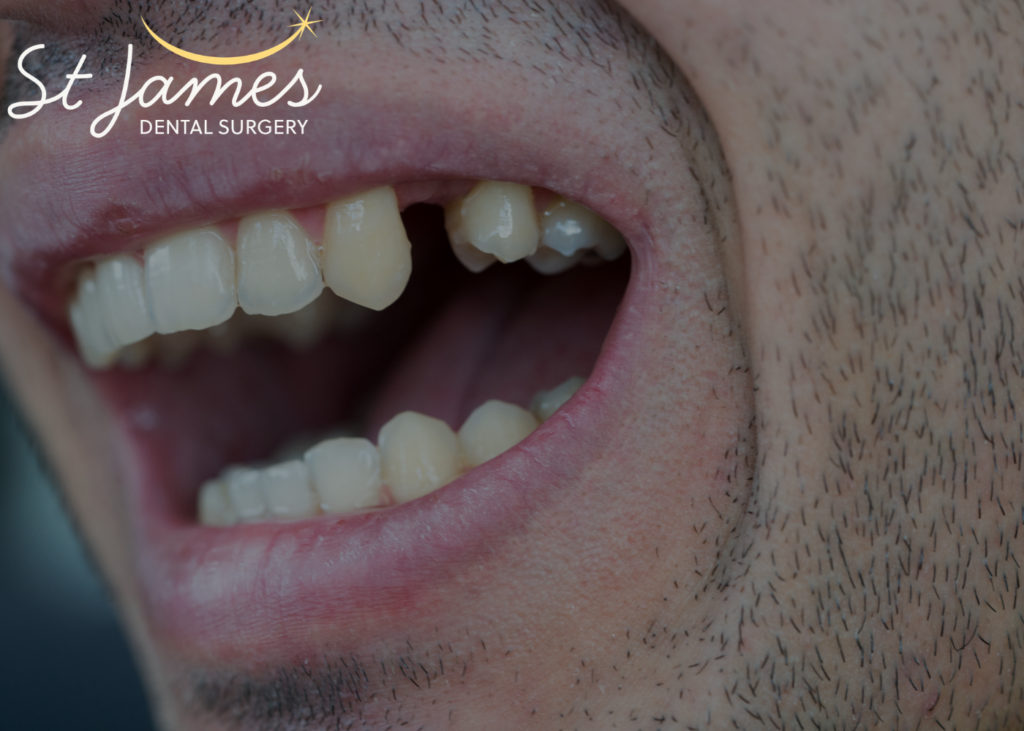
Most people understand that a gap in the smile affects appearance. Fewer people realise the extent to which teeth missing from the arch causes a cascade of structural and functional problems that worsen progressively over time.
Bone Loss: The Silent Consequence
The bone that holds your teeth in place — the alveolar bone — exists specifically to support the tooth roots. The mechanical forces transmitted through a tooth root during biting and chewing stimulate the bone to maintain its density and volume. When a tooth is removed and not replaced, that stimulation stops. The bone has no physiological reason to remain and begins to resorb.
This process starts within weeks of extraction and continues for years. Research consistently shows that patients can lose up to 25% of the bone width at an extraction site within the first year, with both height and width continuing to diminish thereafter. After ten years, the bone loss at an unreplaced extraction site can be dramatic.
This matters for three reasons:
It changes the face. Significant bone loss in the jaw, particularly where multiple teeth have been lost, reduces the vertical height and projection of the lower face — causing the lips to lose their support and the face to take on a collapsed, aged appearance. This is most visible in patients who have worn full dentures for many years.
It affects adjacent teeth. The teeth surrounding an extraction site gradually tilt and drift into the gap over time. This misalignment changes the bite, creates food traps and areas that are harder to clean, and can cause the opposing tooth in the other jaw to over-erupt — moving into the space left by the missing tooth above or below it.
It narrows your future options. Dental implants require adequate bone volume at the implant site. The longer a tooth is left unreplaced, the more bone is lost, and the more likely it becomes that bone grafting will be needed before implant placement can even begin. Replacing teeth promptly preserves options. Waiting closes them.
The Effect on the Remaining Teeth
A complete dental arch works as a unit. Every tooth supports and is supported by its neighbours. When one is missing:
- Adjacent teeth experience altered biting forces and begin to tilt into the space
- The opposing tooth loses its counterpart and can drift or over-erupt
- The teeth on either side of the gap can loosen as the bite becomes unbalanced
- Cleaning becomes harder in the tilted and shifted areas, increasing the risk of decay and gum disease
None of this happens overnight. But over months and years, a single unreplaced missing tooth can compromise the stability of several surrounding teeth.
The Functional Impact
Depending on where the gap is, missing teeth affect chewing efficiency, speech and comfort. A missing back molar forces other teeth to take on disproportionate biting forces. A missing front tooth affects phonetics — particularly sounds involving the tongue and upper teeth. A gap in the aesthetic zone affects confidence in a way that is real and documented: studies consistently show that tooth loss has a measurable impact on quality of life, social confidence and willingness to smile.
What Causes Tooth Loss?
Understanding why teeth are lost helps contextualise both prevention and treatment decisions.
Gum disease (periodontal disease) is the leading cause of tooth loss in adults in the UK. As gum disease progresses, it destroys the bone and ligament supporting the teeth — eventually leaving them with insufficient support to remain in function. This process is largely painless until the late stages, which is why regular dental check-ups that include proper gum assessments are the most reliable preventive measure available.
Tooth decay that progresses to the point where the tooth cannot be saved — where the extent of structural damage or infection makes restoration impractical — accounts for a significant proportion of extractions. In many of these cases, earlier intervention through biomimetic dentistry or restorative treatment could have preserved the tooth. At St James Dental Surgery, Dr Neha Tailor’s biomimetic approach specifically prioritises saving tooth structure where other approaches might proceed to extraction.
Trauma — injuries from accidents, falls or sport — can cause teeth to be knocked out entirely or to sustain damage that makes them unrestorable.
Failed previous dental work — where old crowns, bridges or root-treated teeth eventually fail and the underlying tooth cannot be saved.
Tooth extraction as a planned clinical decision — in cases of irreversible infection, a fractured root, severe periodontal involvement, or to make space for orthodontic treatment. You can find detailed information about what tooth extraction involves and when it is appropriate at our dedicated page.
Missing Teeth Options: A Complete Guide
This is the most important section for most patients reading this article. There is no single correct answer for every situation — the right option depends on how many teeth are missing, where they are, what condition the surrounding teeth and bone are in, your overall health and your priorities. Here is an honest breakdown of every option available.
Dental Implants: The Gold Standard for Tooth Replacement
A dental implant is the closest available equivalent to a natural tooth root. A titanium fixture is placed into the jawbone, where it integrates directly with the bone through a process called osseointegration. Once integrated — typically after three to six months — a crown is placed on top, restoring both the function and appearance of the missing tooth.
Why implants are considered the gold standard:
- They are the only replacement that preserves the bone beneath the gap — the titanium fixture transmits functional loading forces into the bone just as a natural root does, maintaining its density and volume
- They do not require any preparation of the adjacent teeth, unlike bridges
- They function, feel and appear like natural teeth
- With good care, implants can last a lifetime — they are a permanent solution rather than a restoration that needs replacing every ten to fifteen years
- A single implant supports itself independently and does not affect the teeth beside it
When implants may not be immediately possible:
Implants require adequate bone volume and a patient who is medically suitable. Patients who have had a tooth missing for a long time may have insufficient bone and need a bone graft beforehand. Certain medical conditions and medications can affect implant placement. Smoking significantly impairs osseointegration and increases implant failure rates. All of these factors are assessed at the consultation stage.
The upfront cost of dental implants is higher than other options, but their longevity and the fact that they do not damage adjacent teeth make them the most cost-effective long-term solution for most single missing teeth.
Dental Bridge: A Fixed, Non-Removable Option
A dental bridge replaces a missing tooth by suspending a false tooth (pontic) between crowns placed on the teeth either side of the gap — the abutment teeth. The whole structure is permanently cemented in place and functions like a fixed set of teeth.
Advantages of a bridge:
- Fixed in the mouth — no removal required
- Restores appearance and function effectively
- Generally less expensive than an implant at the outset
- Completed in two appointments rather than the several months an implant takes
The significant limitation: The adjacent teeth must be prepared — drilled down — to accept the crowns that anchor the bridge. This involves removing healthy, sound tooth structure from teeth that may otherwise need no work at all. Once that enamel is removed, those teeth will always need a crown. If the bridge fails in the future, both abutment teeth are compromised.
For this reason, a bridge is generally considered the right choice when the adjacent teeth already need crowns for other reasons, or when implants are not possible due to bone loss or medical reasons.
A Maryland bridge uses a different design — a ceramic or metal wing bonded to the back of adjacent teeth rather than full crowns — which preserves more tooth structure. This is a more conservative option for specific situations, typically front teeth where biting forces are lower.
Partial Denture: The Most Accessible Option
A partial denture is a removable appliance that replaces one or more missing teeth. It clips onto the existing teeth and can be removed for cleaning.
When partial dentures make sense:
- Multiple teeth missing across different areas of the arch where implants or bridges would be very complex
- Medical or financial circumstances where implants are not appropriate or accessible
- As a temporary solution while a longer-term plan is being developed
The honest limitations:
- Dentures do not prevent bone loss beneath the gap — the resorption process continues regardless
- They require removal for cleaning, which many patients find inconvenient or socially uncomfortable
- The clips that anchor them to the remaining teeth can place unwanted forces on those teeth over time
- Their fit changes as the underlying bone resorbs, requiring periodic adjustment or replacement
- They are not as stable or comfortable for chewing as fixed options
That said, modern partial dentures — particularly well-designed, well-fitted ones — are significantly better than their reputation suggests. They are a legitimate clinical option and the right choice for certain patients.
Implant-Supported Dentures: The Middle Ground
For patients missing multiple teeth or a full arch, implant-supported dentures use a small number of implants to anchor and stabilise a denture. This dramatically improves the stability of the denture, reduces bone resorption compared to a conventional denture, and restores a level of chewing confidence that free-standing dentures cannot match.
This option combines the accessibility of denture-based tooth replacement with the bone preservation and stability benefits of implant support. For patients who have experienced significant bone loss and are not candidates for individual implants on all missing teeth, implant-retained dentures can be transformative.
Doing Nothing: The Option That Is Not Really an Option
Leaving a gap without any replacement is always an available choice — but it is important to understand what that choice involves over time. The bone loss continues. The adjacent teeth drift. The opposing tooth over-erupts. The bite changes. What starts as a gap that causes no immediate problems gradually creates a clinical situation that is increasingly complex to treat.
Patients who had sufficient bone for a straightforward implant when the tooth was first lost may find, years later, that bone grafting is now needed first. Teeth that drifted into the gap may need orthodontic correction before a bridge or implant can be placed. The cost and complexity of treatment increases in proportion to the time elapsed.
What Makes Dr Neha Tailor's Approach Different?
At St James Dental Surgery in Muswell Hill, Dr Neha Tailor brings something to missing teeth treatment planning that distinguishes her approach: a background in biomimetic dentistry.
Biomimetic dentistry — literally meaning “mimicking life” — is a philosophy and set of clinical techniques that prioritise preserving the maximum amount of natural tooth structure at every decision point. In the context of missing teeth, this shapes the treatment discussion in a specific way:
Before extraction: Can this tooth be saved? Where other dentists might proceed to tooth extraction relatively quickly, Dr Tailor’s biomimetic training means exhausting conservative restoration options first. Teeth that might otherwise be extracted can sometimes be preserved through advanced bonding and restoration techniques that rebuild tooth structure in a way that mimics the original tooth’s properties.
After extraction or loss: Which replacement option preserves the most natural tooth structure in the surrounding teeth? A bridge that involves preparing two healthy adjacent teeth is viewed through a different lens when the clinician’s foundational training is in preservation. Where an implant can achieve the same result without touching the adjacent teeth, that is the recommendation.
Long-term planning: Biomimetic dentistry treats the whole mouth as a system. Missing teeth are not assessed in isolation — they are assessed in the context of the bite, the adjacent teeth, the bone levels and the patient’s long-term dental health trajectory.
What to Do If a Tooth Has Just Been Knocked Out
If a tooth is knocked out in an accident, the speed of your response determines whether the tooth can be reimplanted.
Act within 30 to 60 minutes — this is the window within which reimplantation is most likely to succeed. Beyond an hour, the periodontal ligament cells on the root surface begin to die, and successful reimplantation becomes significantly less likely.
What to do:
- Pick the tooth up by the crown — never touch the root
- If it is dirty, rinse it gently with clean water — do not scrub it
- If possible, place it back into the socket and hold it there — this is the best storage environment
- If you cannot replace it, store it in milk or hold it between your cheek and gum — saliva is a reasonable short-term storage medium
- Get to a dentist or A&E immediately
At St James Dental Surgery, we offer emergency dental appointments for exactly this kind of situation. Time is the critical factor — call us on 020 8365 2090 as soon as the injury happens. Our emergency dental service in Muswell Hill is available for urgent situations that cannot wait, including avulsed teeth, dental trauma, pain and infections.
When Should You Seek Emergency Care for a Missing Tooth?
Missing teeth that have been lost gradually through decay or gum disease do not constitute an acute emergency in most cases — but there are situations involving missing or damaged teeth that need same-day care:
- A tooth knocked out by trauma — act immediately
- Severe pain following a recent extraction (dry socket or infection)
- Swelling of the face, jaw or neck alongside a recently lost tooth or dental pain
- An immediate denture that has broken or become unwearable
- A dental implant crown that has come off or a bridge that has come loose
For any of these, our emergency dentist in Muswell Hill is the right first call. Contact us on 020 8365 2090.
The Bottom Line
Missing teeth — whether one or several — are never just a cosmetic issue. The bone loss, the tooth drift, the bite changes and the narrowing of future treatment options are real and progressive. The sooner a gap is assessed and a replacement plan is made, the more straightforward and less expensive the solution.
Your missing teeth options are genuinely good ones in 2025. Dental implants offer a permanent, bone-preserving, independent tooth replacement. Bridges offer a fixed option when adjacent teeth are already compromised. Dentures offer an accessible and improving solution for more complex situations. And where a tooth might still be saved, Dr Tailor’s biomimetic approach means that restoration is always explored properly before replacement is assumed.
At St James Dental Surgery at 18 Muswell Hill Broadway, London N10 3RT, we take the time to assess your specific situation honestly and recommend the treatment that genuinely serves your long-term dental health — not just the easiest or most expensive option. Call us on 020 8365 2090 to book an assessment.
Disclaimer
The information in this article is intended for general educational guidance only and does not constitute personalised dental or medical advice. Treatment suitability depends on individual clinical circumstances and should only be determined through a proper assessment with a qualified dental professional.
St James Dental Surgery is a private dental practice at 18 Muswell Hill Broadway, London, N10 3RT. Led by Dr Neha Tailor, we offer dental implants, biomimetic dentistry, tooth extractions, emergency dental care, Invisalign, composite bonding, porcelain veneers, teeth whitening, dental crowns, smile makeovers and general dentistry. Call us on 020 8365 2090.
Frequently asked questions
What are the best missing teeth options for a single missing tooth?
For a single missing tooth in a patient with adequate bone and no significant medical contraindications, a dental implant is generally the best long-term option. It replaces the root, preserves the bone, does not affect the adjacent teeth and can last a lifetime with good care. A bridge is a suitable alternative where the adjacent teeth already need crowns for other reasons, or where an implant is not possible. A partial denture is the most accessible option but does not prevent bone loss and is less stable than fixed alternatives.
How quickly does bone loss start after a tooth is extracted?
Bone loss at an extraction site begins within the first few weeks after a tooth is removed. Research shows that up to 25% of bone width can be lost in the first year, with both height and width continuing to diminish over subsequent years. This is why replacing teeth missing from the arch promptly — ideally with a dental implant — is important not just for appearance and function but for preserving the bone that makes future treatment possible.
Can a knocked-out tooth be saved?
Yes, if you act quickly enough. A tooth that has been knocked out completely (avulsed) can sometimes be reimplanted successfully if you reach a dentist within 30 to 60 minutes. Keep the tooth moist — ideally replace it in the socket, or store it in milk — and contact our emergency dentist in Muswell Hill immediately on 020 8365 2090. Do not let time pass — every minute matters in these situations.
What is biomimetic dentistry and how does it relate to missing teeth?
Biomimetic dentistry is an approach that prioritises preserving natural tooth structure using advanced bonding and restoration techniques that replicate the physical properties of natural teeth. In the context of missing teeth, it means thoroughly exploring whether a compromised tooth can be restored before considering extraction, and — where a tooth must be replaced — choosing the option that preserves the most natural tissue in the surrounding teeth. Dr Neha Tailor at St James Dental Surgery applies this philosophy to every restorative treatment decision.
How do I know which missing teeth option is right for me?
The right option depends on how many teeth are missing, where they are, the condition of the surrounding teeth and bone, your medical history, your lifestyle and your long-term goals. There is no universal answer — and any practice that recommends the same treatment to every patient without a proper clinical assessment is not giving you individualised advice. At St James Dental Surgery in Muswell Hill, a thorough clinical consultation with Dr Neha Tailor is the starting point — giving you an honest assessment of your specific situation and a clear explanation of all available options before any treatment is agreed. Call 020 8365 2090 to book.