
White Spots on Tongue
Why They Appear, What Each Cause Means, and When You Need to Act
You notice something in the mirror — a white patch, a cluster of white spots, or a coating on your tongue that was not there before. You are not sure how long it has been there. It might not hurt at all. And yet it is unsettling enough that you are looking for answers.
White spots on the tongue are one of the most searched oral health concerns — and that is largely because the range of possible causes is so wide. At one end of the spectrum, a white coating on the tongue first thing in the morning is a completely normal, daily occurrence that requires nothing more than a tongue scrape. At the other end, certain persistent white patches need clinical assessment because a small number can change over time in a way that matters.
This guide gives you the honest, medically grounded picture. If you have been asking yourself why do I have white spots on my tongue, you will leave this article with a much clearer understanding of what is likely happening, what to do about it, and when to book a dental appointment.
At St James Dental Surgery in Muswell Hill, London, led by Dr Neha Tailor, we carry out thorough oral health assessments at every dental check-up — including a detailed examination of the tongue and all soft tissues. Here is what you need to know.
Understanding Your Tongue Before Looking for Problems
The surface of the tongue is not smooth — it is covered in thousands of tiny projections called papillae, which give it its characteristic texture and house the taste buds. This papillary structure means the tongue naturally traps bacteria, food debris, dead cells and mucus between the projections, particularly at the back of the tongue and after sleep.
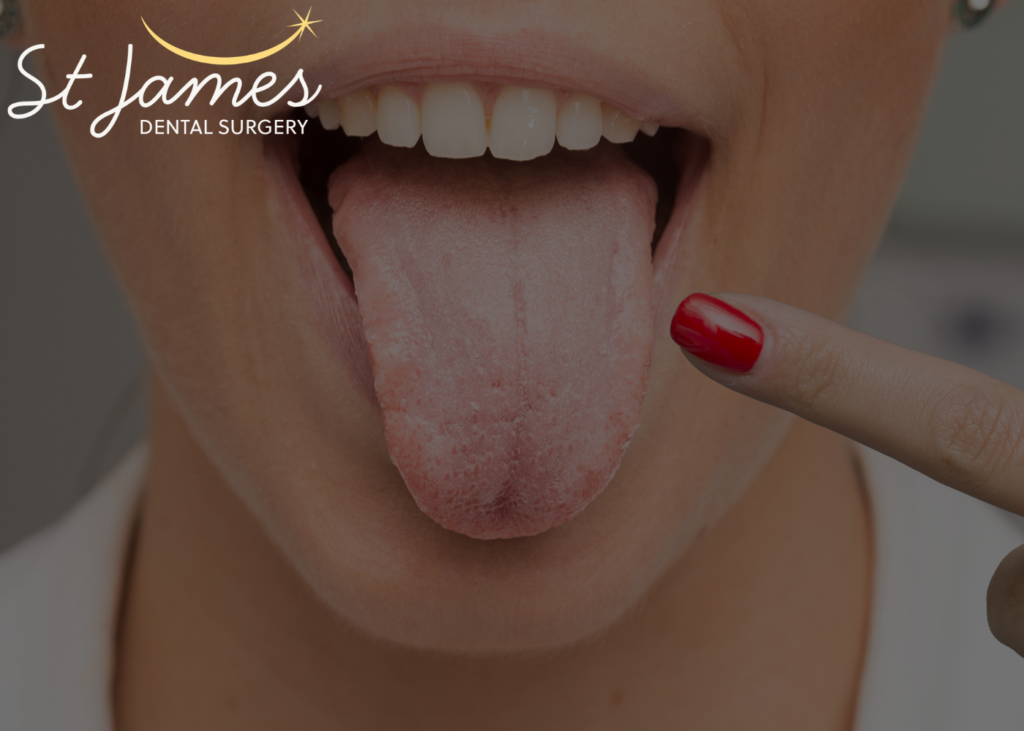
A mild white coating on the tongue surface in the morning, or after eating certain foods, is almost always this accumulation rather than pathology. It responds to tongue cleaning, disappears after eating and drinking, and is not cause for concern.
What deserves attention is a white spot or patch that is persistent — that does not disappear with tongue cleaning or after a few days, that looks different from the general background coating of the tongue, or that has changed in size, shape or texture.
Why Do I Have White Spots on My Tongue? The Main Causes
1. Oral Thrush (Oral Candidiasis)
Oral thrush is a fungal infection caused by Candida albicans — a yeast that normally lives in the mouth in small numbers, kept in balance by competing bacteria, the immune system and saliva. When this balance is disrupted, Candida proliferates and produces a visible infection.
What it looks like: Creamy white patches that resemble cottage cheese or curdled milk. They can appear on the tongue, the inner cheeks, the roof of the mouth and sometimes the throat. The defining clinical feature of thrush is that the patches can be wiped off with a swab or tongue depressor — leaving behind a red, raw, sometimes sore surface.
Common triggers:
- Antibiotic courses (which reduce the competing bacterial population)
- Inhaled corticosteroids (asthma inhalers) — particularly if the mouth is not rinsed after use
- Poorly controlled diabetes
- Dry mouth (reduced saliva reduces the natural anti-fungal defence)
- Immunosuppressive conditions or medications
- Dentures — particularly those that are not cleaned properly or worn overnight
In children: Oral thrush is common in babies and young children, where it appears as white patches inside the mouth that a parent notices during feeding. A children’s dentistry appointment at St James Dental Surgery allows Dr Tailor to assess whether thrush is present and advise on appropriate management.
Treatment: Antifungal medication — typically nystatin suspension or fluconazole — prescribed by a dentist or GP. The contributing factor (inhaler technique, denture hygiene, blood sugar control) should also be addressed to prevent recurrence. Regular dental hygienist appointments are valuable here because a hygienist can monitor the tongue and oral tissues at each visit, identify early changes and maintain the overall oral health environment that helps prevent Candida overgrowth.
2. Aphthous Ulcers (Canker Sores)
Aphthous ulcers are among the most common causes of white spots on the tongue — affecting a significant proportion of the population at some point in their lives. They are not caused by a virus, are not contagious, and are not a sign of anything systemically sinister in most cases.
What they look like: Small, round or oval ulcers with a white or yellowish centre and a red border. They are typically very painful relative to their small size — even a 3–4mm ulcer can cause significant discomfort with eating, drinking and speaking. They most commonly appear on the tongue, the inner cheeks and the floor of the mouth.
Common triggers:
- Stress and fatigue
- Minor trauma — accidentally biting the tongue or cheek, a sharp piece of food, a dental instrument
- Hormonal changes — many women notice a pattern around menstruation
- Certain foods — citrus fruits, tomatoes, coffee, chocolate and nuts are commonly reported
- Nutritional deficiencies — iron, vitamin B12, folate and zinc are associated with recurrent aphthous ulcers
Timeline: Simple aphthous ulcers (under 10mm) heal on their own within seven to fourteen days. No specific treatment is required for most, though topical anaesthetic or anti-inflammatory gels can reduce pain and healing time.
When to seek assessment: Any ulcer that has not healed after three weeks warrants a proper clinical assessment. This applies regardless of how benign it looks — three weeks is the evidence-based threshold at which a transient, benign cause can no longer be assumed. At St James Dental Surgery, soft tissue examination is included at every check-up as standard.
3. Geographic Tongue (Benign Migratory Glossitis)
Geographic tongue is a harmless but visually striking condition in which the tongue develops smooth, reddened patches surrounded by white or whitish-yellow raised borders, creating a map-like appearance. The patches shift location over days and weeks — hence “migratory.”
What it is: The condition results from irregular shedding of the filiform papillae — the tiny projections that cover most of the tongue surface. Where papillae shed in patches and new ones have not yet grown back, the surface appears smooth and red. The white border is the zone of active shedding.
Why do I have white spots on my tongue if it is geographic tongue? The white-bordered patches are often mistaken for other causes of white spots. The key distinguishing features are the red central area, the shifting pattern over time, and the typically absence of pain (some people experience mild sensitivity to spicy or acidic foods).
Significance: Geographic tongue is entirely benign and requires no treatment. If the appearance is causing you concern, having it confirmed by a clinician at a dental check-up removes the uncertainty and gives you the reassurance of a clinical diagnosis.
4. Leukoplakia: The White Patch That Needs Assessment
Leukoplakia is a clinical term for a white or whitish patch on the oral mucosa that cannot be scraped off, cannot be attributed to any other recognised cause, and requires proper clinical assessment. It is defined as a diagnosis of exclusion — other causes are ruled out before the term leukoplakia is applied.
This is the category of white spots on the tongue that requires the most careful attention. While the majority of leukoplakia lesions are benign, a proportion carry malignant potential — meaning that, if left unmonitored, a small number can develop into oral cancer over time. The risk varies depending on site (the lateral border and ventral surface of the tongue carry higher risk than the dorsal surface), clinical appearance (non-homogeneous, speckled or verrucous lesions carry higher risk than uniform flat white patches), and patient risk factors.
Who is most at risk:
- Tobacco users — smoking, chewing tobacco and e-cigarettes all increase risk
- Heavy alcohol drinkers — particularly in combination with tobacco
- Patients with a history of HPV infection
- Patients over 60
What to do: Any white patch on the tongue that has been present for three weeks without a clear, benign explanation should be assessed by a dentist or oral medicine specialist. The assessment will determine whether monitoring is appropriate or whether biopsy is needed to characterise the tissue. Early identification of any pre-malignant change is the difference between straightforward management and complex treatment.
This is one of the core reasons why Dr Neha Tailor includes a thorough soft tissue examination — covering the tongue, cheeks, floor of the mouth, palate and throat — at every dental check-up at St James Dental Surgery. Oral cancer screening is not an optional extra: it is part of what a comprehensive dental examination does.
5. Oral Lichen Planus
Oral lichen planus is a chronic inflammatory condition affecting the mucous membranes. It can present in several ways on the tongue — most characteristically as a network of white lacy lines (Wickham’s striae), though it can also appear as white patches or, in the erosive form, as red, sore areas that are painful and affect eating.
Who gets it: More common in middle-aged adults, particularly women. The cause is an abnormal immune response. It is associated in some cases with hepatitis C infection, certain medications, and in a minority of cases with contact sensitivity to dental materials.
Significance: Oral lichen planus requires monitoring. While the vast majority of cases are benign, the erosive form in particular carries a small but real risk of malignant transformation over years. This is why a confirmed diagnosis should be followed by regular review — which a routine dental hygienist appointment can incorporate alongside professional cleaning.
6. Hairy Tongue (Black, White or Brown)
Hairy tongue is a distinctive and temporarily alarming condition caused by the elongation of the filiform papillae — in normal circumstances 1mm or so long, they can grow to several millimetres. These elongated papillae trap pigment from food and bacteria, causing the tongue to appear white, brown or black depending on the organisms involved.
Common causes:
- Antibiotic use — particularly broad-spectrum antibiotics that alter the oral microbiome
- Poor oral hygiene
- Heavy coffee, tea or tobacco use
- Prolonged use of bismuth-containing medications (such as some antacids)
- Dry mouth
Treatment: Hairy tongue almost always resolves with improved tongue cleaning, increasing fluid intake and addressing the contributing factors. No specific medical treatment is typically needed. A dental hygienist can demonstrate effective tongue cleaning technique and professional clean the tongue during the hygiene appointment.
7. Trauma-Induced White Spots
The tongue is vulnerable to physical trauma — a bite, a sharp piece of food, a hot drink, the edge of a broken tooth or a rough dental restoration. Traumatic injuries to the tongue mucosa produce a white or yellowish appearance as the damaged surface heals, and occasionally a localised ulcer.
These typically resolve within seven to ten days once the source of trauma is removed. A broken tooth or rough restoration edge that is repeatedly catching the tongue needs to be smoothed — a simple procedure at a dental check-up that removes the ongoing irritant and allows the tongue to heal.
8. Food and Drink Coating
Some foods and drinks leave a temporary white residue on the tongue — dairy products, certain cooked starches and some medications can all cause this. This type of white coating clears within minutes of drinking water and bears no resemblance to a pathological white spot: it is uniform, affects the whole tongue surface, and disappears completely.
White Spots on the Tongue in Children
White spots on the tongue in babies, toddlers and children are a common parental concern. The most frequent causes are oral thrush (common in infants and those on antibiotics), milk coating (which clears after water), and minor aphthous ulcers in older children.
At St James Dental Surgery, Dr Neha Tailor welcomes patients of all ages. A children’s dental appointment allows the tongue and mouth to be properly examined, distinguishing between the many benign and common causes and identifying anything that warrants further attention. If your child has a white spot on their tongue that has been present for more than a few days and is not clearly a milk coating, a check-up is the right next step.
The Three-Week Rule: When Any White Spot Needs Assessment
Whatever the appearance and whatever the suspected cause, the clinical standard for any oral soft tissue change — including white spots on the tongue — is clear: if it has not resolved within three weeks, it needs to be assessed by a dentist.
Three weeks is long enough for a transient, self-limiting cause (aphthous ulcer, trauma, thrush) to have cleared if it was going to. Beyond that point, continuing to wait is not cautious — it is delaying the assessment of something that may warrant attention.
This does not mean that anything still present at three weeks is serious. The vast majority of persistent white patches that are properly assessed turn out to have benign explanations. But the small minority that do not are significantly more treatable when caught early — and the only way to know which you are dealing with is clinical assessment.
What Happens at a Soft Tissue Examination at St James Dental Surgery?
Every dental check-up at St James Dental Surgery includes a systematic examination of the soft tissues of the mouth. Here is what Dr Tailor assesses:
Tongue: All surfaces of the tongue are examined — the dorsal (top) surface, the lateral borders (the sides), the ventral (underside) surface, and the tip. The lateral borders and floor of the mouth are the sites of highest risk for oral cancer, making this part of the examination particularly important.
- Floor of the mouth: Examined visually and by gentle palpation.
- Cheeks: Both inner cheeks are examined systematically.
- Palate: Both the hard and soft palate are examined.
- Pharynx and throat: Visible pharyngeal tissue is assessed.
Any white patch, ulcer, or tissue change that is found during this examination is documented, assessed clinically, and a management decision made — whether that is simple reassurance, a short period of monitoring with a follow-up appointment, referral to an oral medicine specialist, or biopsy.
Dr Tailor’s background in biomimetic dentistry reinforces this thorough approach — her clinical philosophy is built around preserving what is healthy, intervening early and conservatively, and never allowing a clinical change to go unaddressed when earlier intervention offers better outcomes. The same conservatism that guides her approach to restoring teeth applies to identifying and managing soft tissue changes: catching things early keeps options open.
The Role of the Dental Hygienist in Soft Tissue Health
The dental hygienist at St James Dental Surgery plays an important supporting role in the ongoing monitoring of oral soft tissue health. Patients who attend regular hygiene appointments every three to six months have their tongue and oral tissues assessed at each visit — meaning any new change is identified much more promptly than it would be on an annual check-up cycle alone.
Beyond monitoring, the hygienist also addresses the oral health factors that contribute to certain causes of white spots on the tongue:
Oral thrush prevention: Maintaining excellent oral hygiene and low bacterial and yeast levels in the mouth creates an environment less conducive to Candida overgrowth. The hygienist appointment includes professional cleaning that removes the plaque and tartar deposits that contribute to an imbalanced oral microbiome.
Tongue cleaning instruction: Effective tongue cleaning — using a scraper or the reverse side of a toothbrush on the dorsal tongue surface — is one of the simplest ways to prevent the bacterial accumulation that produces benign white coating and reduces the conditions that allow yeast to proliferate. The hygienist can demonstrate technique and recommend tools appropriate for each patient.
Monitoring leukoplakia or lichen planus: For patients with a known diagnosis of either condition, regular hygienist appointments at three to four monthly intervals provide the clinical review frequency recommended for active monitoring.
When White Spots on the Tongue Are an Emergency
In most cases, white spots on the tongue are not an emergency. However, the following situations warrant same-day assessment rather than a routine appointment:
- Rapid onset of widespread white patches across the tongue and mouth alongside a fever and difficulty swallowing — could indicate acute primary herpes infection or severe oral thrush in an immunocompromised patient
- A white patch alongside rapidly progressive swelling of the tongue, floor of the mouth or throat
- Any situation where a tongue or mouth change is accompanied by difficulty breathing or swallowing
At St James Dental Surgery, we offer emergency dental appointments in Muswell Hill for situations that cannot wait. Call us on 020 8365 2090 and we will arrange to see you as soon as possible.
The Bottom Line
Why do I have white spots on my tongue? In most cases, the answer is one of the common, benign causes covered in this guide — oral thrush, an aphthous ulcer, geographic tongue, hairy tongue or a coating from food or bacteria that clears with good hygiene. Most of these resolve within days to two weeks, either on their own or with straightforward treatment.
Any white spot on the tongue that persists beyond three weeks needs to be properly assessed by a dentist. Not because it is likely to be serious — the majority of persistent patches turn out to be benign — but because the three-week mark is where self-monitoring stops being clinically appropriate and professional assessment becomes the right approach.
At St James Dental Surgery at 18 Muswell Hill Broadway, London N10 3RT, Dr Neha Tailor and the team provide thorough, systematic soft tissue examinations at every dental check-up, supported by regular dental hygienist appointments that keep the whole mouth under consistent clinical observation. For same-day concerns, our emergency service is available — call 020 8365 2090.
Disclaimer
The information in this article is intended for general educational guidance only and does not constitute personalised dental or medical advice. If you have a white spot or any change in your mouth that has persisted for three weeks or more, please book an appointment with a qualified dental professional for a proper clinical assessment.
St James Dental Surgery is a private dental practice at 18 Muswell Hill Broadway, London N10 3RT, led by Dr Neha Tailor. We offer dental check-ups with soft tissue screening, dental hygienist appointments, children’s dentistry, biomimetic dentistry, dental implants, tooth extractions, emergency dental care, Invisalign, composite bonding, porcelain veneers, teeth whitening and dental crowns. Call us on 020 8365 2090.
Frequently asked questions
What are the most common causes of white spots on the tongue?
The most common causes include oral thrush (a fungal infection producing cream-coloured patches that wipe off), aphthous ulcers (small painful ulcers with a white centre and red border), geographic tongue (red patches with white borders that move around the tongue surface), hairy tongue (elongated papillae trapping pigment) and normal bacterial coating that is thicker in the morning. Most of these are benign and self-limiting. Any white spot that has been present for three weeks without resolving should be assessed at a dental check-up.
Why do I have white spots on my tongue that won't go away?
A white spot or patch on the tongue that does not resolve after two to three weeks of normal hygiene and without a clear cause (like a recent antibiotic course for thrush, or an obvious bite injury) needs clinical assessment. The range of causes includes leukoplakia, oral lichen planus and — rarely — early malignant change. The only reliable way to distinguish between these is examination by a dentist, and in some cases a biopsy. Dr Neha Tailor at St James Dental Surgery includes this as a standard component of every check-up.
Can my dental hygienist help with white spots on the tongue?
Yes, in several ways. The dental hygienist at St James Dental Surgery examines the tongue and oral soft tissues at every hygiene appointment, meaning any new development is identified between annual check-ups. The hygienist also provides tongue cleaning instruction, maintains oral hygiene at a level that reduces conditions favouring thrush, and provides the monitoring schedule recommended for patients with conditions like oral lichen planus or leukoplakia.
Are white spots on the tongue in children something to worry about?
In most cases, no. The most common causes in children are oral thrush (particularly in babies and those recently on antibiotics), temporary milk coating, and minor aphthous ulcers in older children. If a white patch in your child’s mouth has been present for more than a few days and is not clearly a milk residue, a children’s dental appointment will clarify the cause and guide appropriate management. Dr Neha Tailor takes a gentle, thorough approach with younger patients.
What is biomimetic dentistry and how does it relate to tongue and soft tissue assessment?
Biomimetic dentistry is Dr Tailor’s clinical philosophy of preserving what is natural and intervening early and conservatively. This applies to soft tissue assessment in the same way it applies to teeth: catching changes early, assessing them properly, and managing them in the most conservative way possible — rather than waiting until a problem has progressed to a point requiring more significant intervention. Whether the concern is a tooth that needs restoring or a white patch on the tongue that needs monitoring, the underlying principle is the same: earlier is better.