
Gingivitis symptoms
What each one means, why it happens, and when to take it seriously
The gums are one of the most reliably honest parts of the body. They communicate, in specific and clinically meaningful ways, what is happening at the junction between the tooth and the surrounding tissue. The problem is that most people either do not know how to read those signals or dismiss them as normal.
Gingivitis symptoms are rarely dramatic, which is exactly what makes them easy to ignore. Bleeding when you brush. A slight redness at the gum line. A persistent taste that does not go away. Gum tissue that looks puffier than it used to. None of these feel like emergencies, and individually they might seem like minor inconveniences. Collectively, they are telling you something worth listening to.
This article covers gingivitis symptoms in detail: what each one looks like, the clinical mechanism behind it, and what it indicates about the state of the underlying tissue. It also covers the symptoms that signal the condition has progressed beyond gingivitis into periodontitis, which changes the clinical picture significantly, and the circumstances in which symptoms need prompt professional attention.
At St James Dental Surgery in Muswell Hill, London, led by Dr Neha Tailor, whose background in biomimetic dentistry means the entire oral environment is assessed in clinical context, gum health forms a core part of every examination. Call us on 020 8365 2090 or read on for the full clinical picture.
Bleeding on brushing or flossing
This is the most common presenting gingivitis symptom, and it is the one most consistently misinterpreted.
The widespread assumption is that bleeding when brushing means the brush is being used too hard, or that flossing is causing damage. This is almost always incorrect. Healthy gum tissue does not bleed from light contact with a toothbrush or from the passage of dental floss through the interdental space. Healthy gingiva is firm, well-attached to the tooth surface, and contains blood vessels at a depth that normal cleaning simply does not reach.
Why inflamed gums bleed: When plaque accumulates at the gum margin and in the interdental spaces, the bacteria within it produce toxins that penetrate the sulcular epithelium, the thin tissue lining the groove between the tooth and the gum. The immune system responds by increasing blood flow to the area, dilating blood vessels and bringing inflammatory cells to fight the bacterial challenge. This vascular congestion means the blood vessels are enlarged, closer to the surface, and easily ruptured by any contact. A toothbrush that would not cause a healthy gum to bleed causes an inflamed gum to bleed readily.
What the bleeding tells you: Bleeding is not caused by the brushing. The brushing is revealing inflammation that was already there. Stopping brushing or flossing because of bleeding removes the one mechanism disrupting the plaque that caused the inflammation in the first place, making the situation worse within days.
The correct clinical response to bleeding gums is to continue cleaning, improve technique and tools, and assess whether the bleeding reduces over one to two weeks. If it does not reduce, a professional assessment is indicated.
One important qualification: patients on anticoagulant medications (warfarin, apixaban, rivaroxaban, aspirin) will bleed more readily and more persistently from inflamed gum tissue because their clotting is impaired. The inflammation is still the primary cause; the medication amplifies the bleeding response.
Redness and colour change
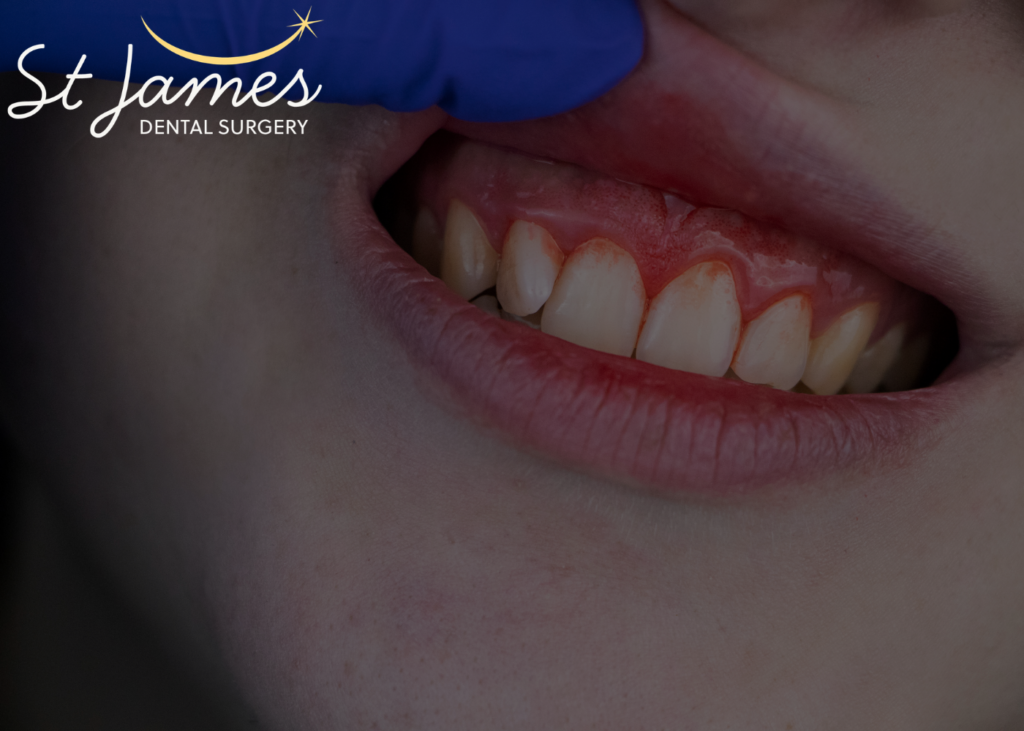
Healthy gum tissue is pale pink, and the shade varies naturally with skin tone and ethnicity. When the tissue is inflamed, the characteristic colour change is toward red, sometimes progressing to a deeper purplish-red in more significant inflammation.
Why this happens: The redness is a direct visual sign of the vascular changes underlying gingivitis. The increased blood flow that causes bleeding also changes the colour of the tissue. The sulcular epithelium, which in a healthy state is relatively impermeable, becomes more permeable as inflammation progresses, and the underlying vascular plexus becomes more visible through the tissue.
What to look for: The redness typically begins at the gum margin, the very edge of the gum tissue where it meets the tooth surface, and at the papillae, the pointed triangular gum tissue between adjacent teeth. These areas are most directly exposed to the bacterial accumulation in plaque.
In chronic, longstanding gingivitis, the colour sometimes becomes more fibrotic: a darker, denser red or even purplish tone that reflects more established inflammatory change in the tissue.
Swelling and a puffy appearance
Inflamed gum tissue is oedematous: it retains fluid as part of the inflammatory response. The tissue appears swollen, rounded, and loses the tight, well-contoured shape that characterises healthy gums. The papillae, which normally form neat triangular points filling the spaces between teeth, become bulbous and blunted.
Why the swelling matters clinically: Swollen gum tissue changes the local anatomy in ways that compound the problem. The enlarged papillae partially cover the interdental space, making it harder to clean effectively and providing an environment where bacteria accumulate more readily. The deeper pseudo-pocket that forms as the swollen tissue envelops the tooth surface increases the depth of the area below the gum line where bacteria can shelter from cleaning.
Medication-related swelling: It is worth noting that some medications, particularly certain calcium channel blockers (amlodipine, nifedipine) used for blood pressure, the immunosuppressant ciclosporin, and the anticonvulsant phenytoin, cause gingival overgrowth: a specific type of gum tissue enlargement that is not the same as inflammation-related swelling but can look similar. The distinction matters for treatment, because medication-induced overgrowth does not fully resolve with cleaning alone.
Tenderness and sensitivity of the gum tissue
Healthy gum tissue is not tender when touched. During a dental examination, the gentle pressure of a periodontal probe against a healthy gum margin produces no discomfort. During a dental examination of inflamed tissue, even light contact produces a recognisable sensitivity, and probing is uncomfortable.
At home: Patients with significant gingivitis often describe the gum tissue as feeling sore or sensitive, particularly when eating certain foods (hot, cold, spicy or acidic foods that contact the inflamed tissue). The sensitivity at the gum margin may be noticed specifically during brushing: not so much during the gentle strokes but where the brush contacts the most inflamed areas.
Tenderness that is severe, that is localised to one specific area, or that is accompanied by swelling and a bad taste should be assessed promptly. Acute gingivitis confined to one area with significant tenderness may indicate a periodontal abscess, which is a distinctly different clinical situation from generalised gingivitis.
Changes in gum texture
This is one of the least-discussed gingivitis symptoms, and one of the more clinically informative.
In a healthy mouth, the attached gingiva (the band of firmer gum tissue that is bound to the underlying bone) has a surface texture called stippling: a finely dotted, orange-peel-like surface that is visible on close inspection. This texture is produced by the attachment of the epithelium to the underlying connective tissue at multiple points.
When the tissue becomes inflamed and oedematous, the stippling disappears. The surface becomes smooth, shiny and slightly glazed in appearance. This change is subtle but reproducible: a clinician examining the gum surface can identify it reliably, and a patient who knows what to look for can notice the loss of the normal textured surface.
The return of stippling as gum tissue recovers from inflammation following treatment is a clinical indicator that the tissue is returning to health.
Halitosis (persistent bad breath)
Bad breath associated with gingivitis has a specific clinical explanation that distinguishes it from bad breath from other causes.
The bacteria responsible for gum inflammation, particularly gram-negative anaerobes that colonise the gum pockets and the dorsum of the tongue in conjunction with gum disease, produce volatile sulphur compounds (VSCs): hydrogen sulphide and methyl mercaptan. These are the same compounds produced in more concentrated amounts by the bacteria of periodontitis and are the primary drivers of the characteristic smell.
Gingivitis-associated bad breath is persistent and does not resolve with brushing or mouthwash, because the source is the bacteria in the inflamed gum pockets and the subgingival plaque, not the food residue on the tongue that normal brushing addresses. Mouthwash may mask it temporarily, but the source remains.
Where bad breath is a significant concern alongside visible gum changes, gum treatment targeting the bacterial source is the appropriate intervention. Professional subgingival cleaning removes the deposits that brushing cannot reach and produces a measurable reduction in VSC levels.
Gum recession: when the tissue pulls back
Recession of the gum margin, where the gum tissue appears to have “pulled back” from the tooth to expose more of the root surface, is not strictly a gingivitis symptom in itself. It is what gingivitis can lead to over time, and it reflects either the bone loss of periodontitis causing the gum to follow the bone, or the mechanical trauma of aggressive toothbrushing on inflamed tissue.
The clinical significance of recession is substantial. The exposed root surface (covered by cementum rather than enamel) is:
- More sensitive to temperature, because the dentinal tubules are closer to the surface
- More susceptible to decay, because cementum is softer and more porous than enamel
- Visually longer, which is why teeth with significant recession look longer than they did
Where recession is identified alongside inflamed gum tissue, the cause must be established before any restoration of the recession site is appropriate. At St James Dental Surgery, the assessment determines whether recession is being driven by disease or by mechanical factors, before any treatment plan is established.
Symptoms that mean gingivitis has become something else
Gingivitis is confined to the gum tissue and is fully reversible with treatment. The symptoms above, while clinically significant, are not permanent. Once the bacterial load is reduced and inflammation resolves, healthy gum tissue returns.
The line into periodontitis is crossed when the infection extends below the gum line, when the bone supporting the teeth begins to be destroyed, and when the attachment between the gum and the tooth root is compromised. The clinical features that indicate this progression include:
Increasing pocket depths: The space between the gum and the tooth deepens beyond 3 to 4mm as the attachment is lost. This is measured at a dental check-up with a periodontal probe.
Visible bone loss on X-ray: The crest of the bone between the teeth drops as it resorbs. This is only visible on X-ray, which is one reason why X-rays at appropriate intervals are clinically essential.
Tooth mobility: Teeth that begin to feel loose, shift position, or develop gaps where gaps did not exist are showing signs of inadequate bone support.
Sustained recession without any toothbrush trauma explanation: Recession that is developing without aggressive brushing, particularly in a specific pattern around certain teeth, may reflect bone-loss-driven tissue changes.
If periodontitis progresses to the point where a tooth cannot be retained, tooth extraction becomes the clinical recommendation, followed by discussion of replacement options including dental implants.
When gingivitis symptoms need urgent attention
Most gingivitis symptoms are chronic and can be assessed at a routine appointment. The following presentations should be seen the same day or the next day:
Acute periodontal abscess: Severe, throbbing pain localised to one area, often with visible swelling on the gum alongside a specific tooth, a bad taste, and sometimes fever. This is not gingivitis: it is an acute bacterial infection that needs immediate drainage and treatment.
Acute necrotising ulcerative gingivitis (ANUG): Sudden onset severe gum pain, characteristic punched-out ulcers at the gum tips between the teeth, a grey pseudomembrane, severe halitosis and sometimes systemic symptoms. This is a clinical emergency requiring same-day professional treatment.
Rapidly increasing facial swelling: Any dental infection that is spreading into the face or neck needs urgent assessment. This is a medical emergency if swallowing or breathing is affected.
For any of these presentations, contact St James Dental Surgery’s emergency dental service in Muswell Hill for same-day assessment.
How gingivitis is treated: the clinical sequence
The treatment for gingivitis follows a clear sequence.
Step 1: Professional cleaning. The bacteria driving gingivitis are in the plaque and tartar at and below the gum line. Tartar cannot be removed by brushing. Professional scaling by a clinical professional removes it, and the reduction in bacterial load allows the tissue to begin recovering within days.
Step 2: Subgingival cleaning where indicated. If pockets are deeper than 3mm, tartar and bacteria have established themselves beneath the gum line, and gum treatment involving root surface debridement is needed to clean the root surfaces within the pockets.
Step 3: Improved home care. Professional cleaning resets the tissue, but bacteria re-colonise within days. Consistent daily brushing and interdental cleaning is the maintenance mechanism. The clinician advises on specific areas being missed, appropriate tools and correct technique.
Step 4: Reassessment. At a follow-up appointment, pocket depths and bleeding are reassessed to confirm the tissue has recovered as expected. Where it has not, further professional treatment is planned.
Biomimetic dentistry and the gum-tooth relationship
Where gingivitis has progressed and teeth have been affected by the underlying disease, the restorative approach taken matters considerably. Dr Neha Tailor’s practice of biomimetic dentistry is directly relevant here: biomimetic principles prioritise preserving the maximum amount of natural tooth structure when restoring teeth that have been compromised by decay, gum disease or recession-related root exposure.
This is not simply about technique. It is about a philosophy that considers the long-term health of the tooth within its periodontal environment, understanding that healthy gums around a well-restored tooth produce better outcomes than cosmetic work on a tooth whose supporting structures are compromised.
In practical terms, this means that gum health is always addressed before any restorative treatment, and that the restorations placed at St James Dental Surgery are designed with the gum tissue and the tooth’s biological behaviour in mind, not just the aesthetic outcome at the time of placement.
The bottom line
Gingivitis symptoms are the body communicating that the gum tissue is under bacterial challenge. Bleeding on brushing, redness, swelling, texture change, tenderness, bad breath and recession are each a specific and readable sign. The appropriate response to each is not to dismiss it but to understand what it is saying and act accordingly.
Most gingivitis is reversible. The gingivitis that progresses to periodontitis is not. And the tooth loss that follows advanced periodontitis is permanent, requiring implants or other replacement options where bone levels allow.
The earlier gingivitis symptoms are recognised and addressed, the simpler the treatment and the better the outcome. At St James Dental Surgery in Muswell Hill, 18 Muswell Hill Broadway, London N10 3RT, Dr Neha Tailor and the team provide thorough periodontal assessment, gum treatment and the kind of clinical care that treats the whole picture. Call 020 8365 2090 if you have concerns.
Disclaimer
The information in this article is intended for general educational guidance only and does not constitute personalised dental advice. For concerns about gingivitis symptoms or gum health, please book an appointment with a qualified dental professional for a proper clinical assessment.
St James Dental Surgery is a private dental practice at 18 Muswell Hill Broadway, London N10 3RT, led by Dr Neha Tailor. We offer gum treatment, biomimetic dentistry, dental implants, emergency dental care, tooth extractions, Invisalign, composite bonding, porcelain veneers, teeth whitening, dental crowns, dental check-ups and smile makeovers. Call 020 8365 2090.
Frequently asked questions
Which gingivitis symptoms appear first?
Bleeding on brushing or flossing is typically the first noticeable symptom, often before any visible redness or swelling has developed. The bleeding occurs because the vascular changes of early inflammation make the blood vessels close to the surface more fragile, even before the gum looks significantly different. Patients who notice new bleeding when brushing and have not changed their technique or brush should treat this as a signal, not an explanation to look for in their brushing habits.
Can gingivitis symptoms come and go?
Yes. Gingivitis symptoms can fluctuate. Periods of better brushing temporarily reduce the bacterial load and the inflammation partially subsides. Then plaque accumulates again, the inflammation returns. This waxing and waning can give the false impression that the problem is resolving when it is not. It can also mean patients dismiss the symptoms as variable rather than persistent. A clinical assessment with pocket depth measurements and X-rays gives an accurate picture of what is actually happening with the gum and bone, independent of day-to-day fluctuation.
Do gingivitis symptoms hurt?
Not typically, in the way most people expect pain. The tissue may be tender when touched, and some patients describe a dull ache or sensitivity at the gum margin, but the kind of acute pain that makes someone seek help is usually not a feature of gingivitis. This is part of what makes it easy to ignore. Acute pain is a feature of an abscess or of ANUG, both of which are different and more urgent presentations. Gingivitis is mostly silent, which is why the other symptoms, particularly the bleeding, matter so much as early indicators.
How long does it take for gingivitis symptoms to resolve with treatment?
With professional cleaning and a significant improvement in home care, most patients see visible reduction in bleeding and swelling within two weeks. Complete resolution of the inflammatory signs in tissue that has not had permanent structural damage typically takes four to six weeks. Where tartar was extensive or pockets were deeper, the timeline is longer and may require a second professional cleaning session. A gum treatment appointment establishes the baseline and a follow-up assessment confirms whether the tissue has recovered as expected.
If my gingivitis symptoms go away, has the gum disease been cured?
The resolution of symptoms means the inflammation has been brought under control and the tissue has returned to a healthier state. It does not mean the bacteria have been permanently eliminated or that the condition cannot return. Bacteria re-colonise cleaned surfaces within days and plaque forms continuously. This is why maintenance through consistent home care and regular professional cleaning is not a temporary measure after treatment: it is the ongoing mechanism for preventing the inflammation from returning. The emergency dentist in Muswell Hill is available if symptoms return acutely, but the routine hygiene appointments and check-ups are what prevent it from reaching that point.