
How to remove stains from teeth
What actually works, what does not, and where to start
If you have noticed your teeth looking yellower, darker or more uneven in colour than they used to, you are not imagining it — and you are not alone. Tooth discolouration is one of the most common reasons patients start looking into cosmetic dental treatment, and one of the most common reasons they are disappointed when the first product they try does not work as expected.
The reason for that disappointment is almost always the same: the wrong treatment for the type of stain.
Before you can remove stains from teeth effectively, you need to understand which kind of staining you are dealing with. Not all tooth discolouration responds to the same interventions. Some stains are on the surface of the enamel and can be polished away by a hygienist. Others are within the enamel and dentine and need whitening agents to address them. Others are caused by structural changes to the tooth that whitening cannot reach, and require a different approach entirely.
This guide works through all of it. Clearly, specifically, and in the right order.
At St James Dental Surgery in Muswell Hill, led by Dr Neha Tailor, we help patients understand their specific type of tooth discolouration and find the most effective — and most conservative — route to improving it. The right starting point makes all the difference.
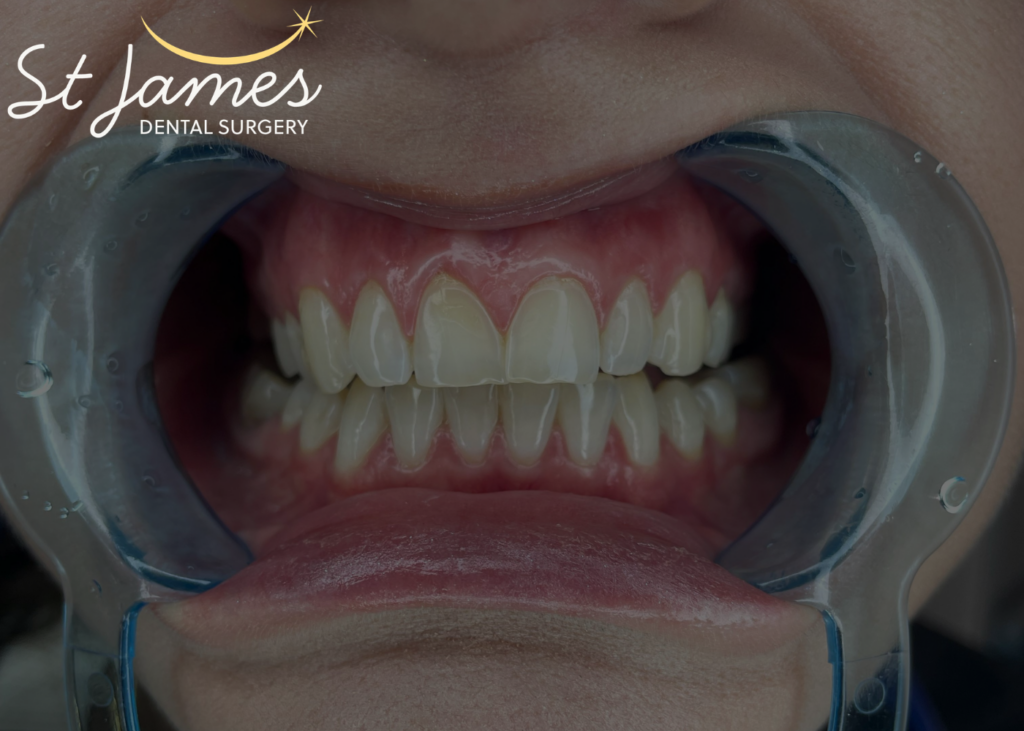
Two fundamentally different types of tooth stain
Everything starts here, because the two categories of tooth staining are treated in completely different ways.
Extrinsic staining sits on the outer surface of the tooth — on the enamel itself, or in the pellicle (the thin protein film that coats the tooth surface). It is caused by pigmented compounds from food, drink or tobacco that adhere to or penetrate the outer enamel surface. Extrinsic staining responds to professional cleaning and, where the pigment has penetrated slightly deeper, to tooth whitening.
Intrinsic discolouration originates within the tooth structure itself — in the dentine or, occasionally, in the enamel. It is caused by structural changes that affect how the tooth absorbs and reflects light. Whitening can improve some types of intrinsic discolouration, but others require a different approach.
Most patients have a combination of both — some surface staining from lifestyle sources and some degree of underlying intrinsic yellowing from ageing or other causes. Understanding the proportion of each is what determines which treatment or combination of treatments will produce the best result.
What causes each type of staining
- Coffee and tea staining Cause: tannins adhering to enamel surface. Responds to whitening: yes. Best approach: hygienist clean followed by professional whitening.
- Red wine staining Cause: chromogens and tannins. Responds to whitening: yes. Best approach: hygienist clean followed by professional whitening.
- Tobacco staining Cause: tar and nicotine penetrating the enamel. Responds to whitening: partially. Best approach: hygienist clean plus whitening; cessation essential for lasting results.
- Age-related yellowing Cause: dentine darkening as the pulp recedes, combined with enamel thinning over time. Responds to whitening: yes, with significant improvement. Best approach: professional tooth whitening.
- Tetracycline staining Cause: antibiotic incorporated into developing dentine during childhood. Responds to whitening: limited improvement only. Best approach: porcelain veneers in most cases.
- Fluorosis Cause: excess fluoride intake during tooth development, producing white spots or brown patches. Responds to whitening: variable. Best approach: whitening, microabrasion, bonding or veneers depending on severity.
- Trauma-related darkening Cause: internal haemorrhage following an injury, with blood products seeping into the dentine tubules. Responds to whitening: limited with external whitening; internal bleaching may help. Best approach: specialist assessment; possible bleaching from inside the tooth.
- Decay-related discolouration Cause: bacterial breakdown of tooth structure producing dark areas. Responds to whitening: no — the decay itself needs treating. Best approach: filling, crown or biomimetic restoration.
- Metal restoration shadows Cause: old amalgam fillings casting a grey shadow through the overlying tooth structure. Responds to whitening: no. Best approach: replacing the restoration; biomimetic techniques often allow this conservatively.
Extrinsic staining: what removes it and how
The surface staining from coffee, tea, red wine and tobacco accumulates progressively over months and years, and the rate at which it builds up depends on the volume consumed, the frequency, and whether steps are taken to limit it.
Professional hygiene cleaning: the most effective first step
For extrinsic staining, a dental hygienist appointment is the most direct and most effective intervention. The hygienist has access to tools and materials that home cleaning simply cannot replicate:
Air polishing — a jet of sodium bicarbonate powder mixed with water and air — is particularly effective for removing surface staining. It reaches between teeth, at the gum margins and into any grooves or pits in the enamel surface. A single air polishing session removes months of accumulated coffee, tea and tobacco staining in a way that no toothpaste, however “whitening” its marketing claims, can approach.
Ultrasonic scaling removes the tartar (hardened plaque) that builds up alongside surface staining. Tartar absorbs pigment and holds it against the tooth surface — removing tartar is often the step that most noticeably brightens the appearance of the teeth.
Prophylaxis paste polishing using a rubber cup finishes the appointment by removing any residual surface film and leaving the tooth surface smooth and less prone to immediate re-staining.
If you have not had a hygienist appointment recently, this is always the correct first step before considering whitening. Whitening works on clean tooth surfaces — applying whitening to teeth covered in surface staining and tartar reduces its effectiveness significantly.
Home care for surface staining
Consistent home care does not remove established staining but it genuinely slows the rate of accumulation:
- Rinsing with water after coffee or red wine washes away chromogens before they adhere
- Electric toothbrushes remove more surface plaque and mild staining than manual brushes for most people
- Whitening toothpastes with mild abrasives can maintain the surface polish achieved at a hygiene appointment, but they do not produce the same results as professional cleaning and do not change intrinsic tooth colour
- Drinking through a glass rather than allowing prolonged contact between pigmented drinks and the tooth surface reduces staining
Intrinsic discolouration: when you need professional tooth whitening
When surface cleaning alone does not produce the brightness you are looking for, the discolouration is intrinsic — within the enamel and dentine — and professional teeth whitening is the appropriate next step.
Professional tooth whitening uses hydrogen peroxide or carbamide peroxide (which breaks down into hydrogen peroxide) at concentrations far higher than anything available in over-the-counter products. In the UK, dentist-prescribed whitening gels can contain up to 6% hydrogen peroxide for home use — compared to the 0.1% limit on consumer products.
The peroxide compound penetrates the enamel surface and reaches the dentine beneath, where it reacts with the chromogen molecules responsible for discolouration. Through oxidation, these pigment chains are broken apart, producing a lighter, brighter tooth.
Custom tray whitening: the most effective and most controllable method
Custom tray whitening — where impressions or digital scans of your teeth are used to fabricate closely fitting trays through which you apply the whitening gel at home — is the gold standard for achieving the best and most controlled results:
- The trays hold the gel in close, precise contact with the tooth surface
- The amount of gel and the duration of each session can be precisely controlled
- The results are achieved gradually, which produces better colour stability than accelerated in-surgery methods
- The trays are reusable indefinitely — top-up gel can be purchased to maintain results over years
Most patients achieve their target shade within two to four weeks of nightly use. Once the result is achieved, occasional maintenance use (a few nights every three to six months) keeps the teeth at a consistent shade long-term.
In-surgery whitening
In-surgery whitening uses a higher-concentration gel applied by the dental team in a single appointment. The advantage is speed — significant brightening in one session. The limitation is that the result sometimes involves an element of post-treatment dehydration of the enamel that temporarily makes the teeth appear whiter than their settled shade, and the results can be shorter-lived without a take-home maintenance system.
The most effective protocol for removing stains from teeth comprehensively often combines an in-surgery session for immediate impact with custom take-home trays for long-term maintenance.
What whitening cannot do
It is important to be honest about the limits of professional teeth whitening, because patients sometimes expect results that are not achievable with whitening alone:
- Whitening cannot change the colour of existing crowns, veneers, bridges or composite restorations — only natural tooth enamel responds to the peroxide compound
- Severe tetracycline staining produces limited improvement with standard whitening — the bands of discolouration are incorporated into the dentine at a structural level that peroxide cannot fully reach
- Trauma-related grey/dark teeth may require internal whitening from inside the root canal space, or a more complex restoration approach
- Very thin enamel — from acid erosion or heavy wear — limits both the degree of whitening achievable and the suitability of whitening treatment
When to consider something beyond whitening
For discolouration that does not respond adequately to professional cleaning and whitening, there are cosmetic options that address the appearance from the outside:
- Composite bonding — composite resin applied directly to the tooth surface — can mask underlying discolouration with a colour-matched layer that looks natural. It is reversible, completed in a single appointment, and significantly less invasive than veneers. It works well for isolated discoloured teeth or where a moderate improvement in overall appearance is the goal alongside whitening.
- Porcelain veneers — thin ceramic shells bonded to the prepared tooth surface — offer the best opacity and colour stability for severe discolouration. A veneer effectively covers the front surface of the tooth entirely, replacing its visual appearance with the colour chosen at the design stage. Veneers require permanent preparation of the enamel surface and are not reversible, which makes the decision to place them a more significant clinical and personal commitment.
- Biomimetic restoration — Dr Neha Tailor’s specialist approach at St James Dental Surgery — applies techniques and materials that restore teeth in a way that preserves the maximum amount of natural tooth structure while addressing functional and aesthetic concerns simultaneously. Where the discolouration is associated with tooth damage, old restorations casting metallic shadows, or structural changes that affect the tooth beyond cosmetics, biomimetic principles often allow for a more conservative resolution than conventional approaches — restoring the tooth to look natural without the degree of enamel removal that more aggressive restorations require.
The right sequence matters — always whiten first
If you are planning any cosmetic restorations alongside whitening, the sequence is important:
Whiten before any composite or ceramic work. Composite resin and porcelain do not respond to whitening agents. If bonding or veneers are placed first and you subsequently whiten the surrounding natural teeth, a shade mismatch is created between the restorations and the whitened teeth — and the only solution is to replace the restorations.
The correct order: complete whitening, allow two to three weeks for the shade to stabilise, then match any composite or ceramic work to the whitened shade.
This sequencing is discussed at the consultation stage at St James Dental Surgery, and any treatment plan that involves multiple cosmetic elements is structured in the correct order before any treatment begins.
Maintaining results: the hygienist's ongoing role
Whatever combination of treatments is used to remove stains from teeth effectively, the results need maintenance. The dietary and lifestyle habits that caused the staining in the first place do not stop after whitening, and the natural ageing process continues regardless of treatment.
Regular dental hygienist appointments are the most consistent maintenance mechanism:
- Professional cleaning removes the surface staining that accumulates between whitening top-ups
- Air polishing keeps the tooth surface smooth and bright without abrasive toothpaste
- The hygienist can identify early signs of new staining patterns and advise on dietary or home care adjustments before significant discolouration re-establishes itself
- For patients with restorations — bonding, veneers, crowns — the hygienist uses appropriate instruments and materials that clean effectively without damaging the restoration surface
For patients who have invested in whitening or cosmetic work to remove stains from teeth, a hygienist appointment every three to six months is the most reliable way to protect that investment over time.
What does not work — and why
Charcoal toothpaste: Despite its popularity, activated charcoal toothpaste is not effective for removing intrinsic staining and carries a real risk of abrasive damage to the enamel surface. Its stain-removal action is purely mechanical — it is an abrasive — which can temporarily produce a brighter appearance by removing the superficial pellicle but does nothing for underlying discolouration and progressively damages the enamel. Not recommended.
Oil pulling: Swishing oil around the mouth has no clinically evidenced effect on tooth colour. It may have marginal antimicrobial benefit in some studies, but it does not remove extrinsic staining and has no mechanism for affecting intrinsic discolouration.
Lemon juice / baking soda: Both are acidic (lemon) or mildly abrasive (baking soda) and can remove some surface film. Repeated application of anything acidic to the enamel surface causes irreversible erosion — the very thinning of enamel that makes teeth look darker and less vital over time. Not a recommended approach.
Over-the-counter whitening strips: UK-legal strips are restricted to 0.1% hydrogen peroxide — far below the concentration needed to produce meaningful whitening. Some reduction in very mild surface-level yellowing may occur, but results are minimal and inconsistent. If whitening is the goal, the investment in dentist-prescribed custom tray whitening produces reliably better results for a comparable cost over time.
The bottom line
Removing stains from teeth effectively starts with identifying which type of staining you have. Surface staining from diet and lifestyle responds to professional hygiene cleaning. Intrinsic discolouration responds to professional whitening. Severe or structural discolouration may need composite bonding, veneers or a biomimetic restoration approach.
The most common mistake is skipping the first step — a hygienist appointment — and going straight to whitening on teeth that still have surface staining and tartar obscuring the natural tooth colour. A professional clean first makes whitening more effective and often produces a more dramatic improvement than either alone.
At St James Dental Surgery in Muswell Hill, Dr Neha Tailor and the team take the time at consultation to identify the correct type of staining, explain what is actually achievable, and plan the most conservative and effective route to the result you want. For appointments, call 020 8365 2090 or visit us at 18 Muswell Hill Broadway, London N10 3RT.
Disclaimer
The information in this article is intended for general educational guidance only and does not constitute personalised dental advice. For a proper assessment of your specific tooth discolouration and the most appropriate treatment, please book a consultation with a qualified dental professional.
St James Dental Surgery is a private dental practice at 18 Muswell Hill Broadway, London N10 3RT, led by Dr Neha Tailor. We offer professional teeth whitening, dental hygienist appointments, biomimetic dentistry, emergency dental care, composite bonding, porcelain veneers, dental implants, Invisalign, dental crowns and smile makeovers. Call 020 8365 2090.
Frequently asked questions
Can all tooth stains be removed?
Most extrinsic staining — from coffee, tea, wine and tobacco — can be significantly reduced or eliminated with professional hygienist treatment and professional teeth whitening. Intrinsic discolouration from ageing responds well to whitening in most cases. More complex intrinsic staining from tetracycline, fluorosis, trauma or developmental causes responds variably — some cases improve significantly with whitening, others require composite bonding, veneers or a biomimetic restoration to fully resolve. A proper assessment establishes which applies.
Does professional teeth whitening damage the enamel?
When carried out correctly using dentist-prescribed materials, professional teeth whitening does not permanently damage enamel. Studies on the structural effects of peroxide-based whitening consistently show no significant alteration to enamel mineral content or surface hardness with standard treatment protocols. Some patients experience temporary sensitivity during or after whitening — this is caused by the peroxide reaching the dentine and stimulating the pulp, and resolves within a few days of completing treatment. Using a desensitising agent alongside the whitening gel reduces this significantly.
How long does professional whitening last?
The results from professional teeth whitening typically last one to three years before significant colour reversion occurs, depending on diet and lifestyle. With periodic maintenance whitening (a few nights with the take-home trays every three to six months) and regular hygienist appointments to remove surface staining between sessions, many patients maintain their results almost indefinitely.
I have veneers or crowns — can I still whiten my teeth?
Whitening agents work only on natural tooth structure — they have no effect on ceramic veneers, crowns or composite restorations. If you have existing restorations on the visible front teeth, whitening the natural teeth around them may create a shade mismatch. This is best assessed at a consultation before any whitening is started, so the approach can be planned appropriately. In some cases, the correct sequence is to whiten and then replace any restorations to match the whitened shade.
My tooth went dark after an injury — what are my options?
A tooth that darkens after trauma has typically undergone internal haemorrhage — blood products from the damaged pulp have seeped into the dentine tubules and produced the characteristic grey-brown discolouration. The options depend on whether the pulp is still vital. If the tooth has had root canal treatment, internal bleaching — applying whitening gel inside the root canal space from within the tooth — can produce significant improvement. If the discolouration is not amenable to internal whitening, a veneer or biomimetic restoration can address the appearance from the outside. This type of case requires proper assessment — contact St James Dental Surgery on 020 8365 2090 to discuss your options.