
Eating after teeth removal
What to eat, what to avoid, and how to protect the healing socket
You have just had a tooth removed — or you are about to — and eating is suddenly a more complicated subject than it usually is. You are hungry, you are not sure what is safe, and the last thing you want is to disturb the socket and end up back at the dentist for something preventable.
Eating after teeth removal requires a bit of care, especially in the first 24 to 48 hours. The healing process in the empty socket is fragile at first, and the food choices you make during this period directly affect how smoothly recovery goes. The good news is that the dietary restrictions are temporary, and for most people they are less limiting than expected once you know the reasoning behind them.
This guide covers everything clearly: why the first hour matters so much, what to eat and when, the foods that genuinely put healing at risk, and how long before things return to normal. It also covers the specific situation of eating after teeth removal that involves multiple extractions or implant placement — where the considerations are slightly different.
At St James Dental Surgery in Muswell Hill, London, led by Dr Neha Tailor, we carry out tooth extractions as carefully as possible and provide thorough aftercare guidance every time. Here is the complete picture.
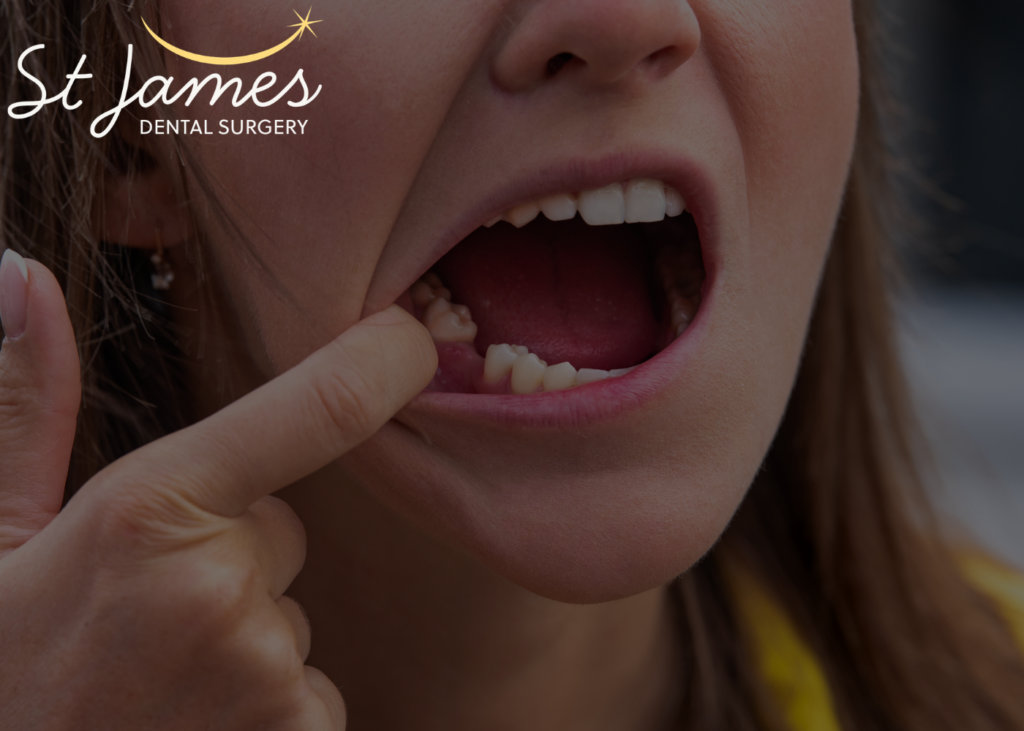
The first hour: why eating anything right now is a bad idea
In the immediate hour after a tooth extraction, the socket is going through its most critical phase: blood clot formation.
When the tooth is removed, a blood clot forms in the empty socket within minutes. This clot is not an inconvenience — it is the biological scaffolding on which the entire healing process is built. It protects the exposed bone and nerve endings at the base of the socket, initiates the inflammatory cascade that begins tissue repair, and prevents bacteria from reaching the raw bone directly.
Eating anything during this first hour — even something soft — risks disturbing this clot before it has properly organised. Chewing movements, the texture of food against the socket, and the suction and pressure of swallowing all create mechanical forces in the mouth that the newly forming clot cannot withstand.
The rule for the first hour is straightforward: do not eat and do not drink anything hot. Plain water at room temperature is fine. Everything else waits.
If gauze was placed over the socket to help control bleeding, keep it in position with gentle biting pressure for the duration advised by your dentist — typically 30 to 45 minutes. Do not replace or disturb it to eat.
The recovery timeline: what to eat and when
Time after extraction | What is safe | What to avoid |
0–1 hour | Room temperature water only | Everything else |
1–3 hours | Cold or room temperature soft foods if anaesthetic has worn off | Hot food and drinks, anything requiring biting |
Hours 3–24 | Soft, cool or lukewarm foods on the opposite side | Hard, chewy, crunchy, spicy, very hot, sticky |
Days 2–3 | Soft diet continues; mild temperature variation becoming acceptable | Anything requiring pressure near the socket |
Days 4–7 | Progressively more normal foods as comfort allows | Crunchy, hard or very chewy foods near the socket |
After 1 week | Most people can eat normally, guided by comfort | Any food that causes pain near the socket |
What to eat in the first 24 hours
The 24-hour window after an extraction is the most important for undisturbed clot formation. The dietary goal during this period is simple: soft foods that require minimal chewing, at cool or room temperature, eaten on the side of the mouth opposite the extraction.
Foods that work well:
- Yoghurt — easy to eat, no chewing, can be cold which provides mild comfort at the socket site
- Soup — lukewarm, not hot; broth-based or blended soups are ideal. Avoid noodle soups with long strands that require sucking
- Mashed potato — soft, filling and easy to eat with very little jaw movement
- Scrambled eggs or soft-boiled eggs — protein-rich, soft, and easy to manage
- Porridge — smooth texture, filling, easy to eat with a spoon
- Avocado — requires no chewing when ripe, nutritious, and easy to eat in slices or mashed
- Smoothies — nutritious and liquid, but drunk through a glass rather than a straw (see below)
- Soft fish — salmon, cod or similar that flakes without significant bite force
- Banana — soft, filling, no chewing required
- Ice cream — cold is actually beneficial in the early hours (reduces swelling); choose varieties without hard pieces, cones or chewy mix-ins
- Soft cooked pasta — cooked until very soft and served with a smooth sauce
The common thread: all of these require minimal jaw movement, do not produce crumbs or fragments that could enter the socket, and do not require biting with the teeth near the extraction site.
What not to eat — and why each one matters
Some of these restrictions are obvious; others are less intuitive. Here is the clinical reasoning behind each.
Hot food and drinks
Heat causes vasodilation — widening of the blood vessels. In the area of a fresh extraction socket, this increases blood flow and increases the risk of the clot being dislodged or the socket bleeding more than it should. This is why the restriction on hot food is specifically during the healing phase, not just general caution. Avoid anything above body temperature for at least 24 hours, and be cautious for 48 to 72 hours.
Alcohol
Alcohol is a vasodilator and also interferes with blood clotting. Drinking alcohol in the 24 hours following an extraction — or while taking any prescribed painkillers — significantly increases the risk of bleeding and impairs the initial healing response. Avoid entirely for at least 24 hours; 48 is better.
Straws
This is one of the most important restrictions and one of the most commonly ignored. The suction motion of drinking through a straw creates negative pressure in the oral cavity that can physically dislodge the blood clot from the socket. Once the clot is lost, the condition known as dry socket (alveolar osteitis) develops — the bone and nerve endings are exposed, producing a severe, throbbing pain that begins two to four days after the extraction and requires treatment. Avoid straws for at least five to seven days.
Smoking
The same suction action as straws applies here — and nicotine additionally causes vasoconstriction that impairs the blood supply to healing tissue, significantly slowing recovery and substantially increasing dry socket risk. Research consistently shows smokers are several times more likely to develop dry socket than non-smokers following an extraction. If there was ever a window to stop, or at minimum to significantly reduce, this is it.
Hard and crunchy foods
Crisps, crackers, raw vegetables, nuts, seeds, toast — anything that produces sharp fragments when bitten is a genuine hazard to the extraction socket. Small, hard fragments of food can lodge in the socket and displace the clot, or physically irritate the healing tissue. Beyond the socket risk, biting on hard foods near an extraction site is painful in the early days regardless.
Chewy and sticky foods
Toffee, chewing gum, chewy bread, dried fruit, gummy sweets — anything that requires sustained chewing force or that sticks to the teeth. Chewy foods require jaw movement patterns that place strain on the socket area and risk disturbing the clot. Sticky foods can adhere in the socket space.
Spicy foods
Spicy food causes irritation and increased blood flow to the mucosal lining of the mouth. It can cause stinging and pain at the raw socket margins, and may contribute to increased inflammation during a period when allowing the normal healing inflammatory process to proceed undisturbed is the clinical goal.
Fizzy drinks
The carbonation in fizzy drinks creates pressure within the mouth that can disturb the socket clot. Additionally, the acidity of most carbonated drinks is a direct irritant to exposed wound tissue. Avoid for the first 24 to 48 hours.
Eating on the other side — is it always safe?
A common belief is that eating on the side opposite the extraction is completely safe. For most simple extractions, it largely is — but with some nuance.
Chewing on the other side reduces direct pressure on the healing socket, but swallowing and jaw movement still involve the whole mouth to some degree. For extractions at the very back of the mouth — wisdom teeth in particular — the movement of the jaw during chewing affects the whole posterior region. Sticking to soft foods for the first 48 hours means this is not a problem regardless of which side you chew on.
For patients who have had multiple extractions on the same occasion — sometimes necessary when several teeth are too compromised to save — the option of chewing on one side may not exist. In this case, the emphasis on very soft foods is even more important, and the healing period may require a slightly more restricted diet for longer.
Drinking after a tooth extraction
The rules for drinking are slightly different from those for eating, and worth separating out.
What is safe:
- Room temperature or cold water at any point after the first 30 to 45 minutes
- Cold drinks generally (non-fizzy, no straw) — the cold actually helps with swelling in the early hours
- Lukewarm herbal teas from the following day, avoiding the socket area
What to avoid:
- Hot drinks for at least 24 hours
- Anything consumed through a straw for at least five to seven days
- Alcohol for at least 24 hours (48 recommended)
- Fizzy drinks for 24 to 48 hours
Staying hydrated is important for healing — dehydration impairs every aspect of the recovery process. The restrictions are on what you drink, not on whether you drink. Keep fluid intake up throughout the recovery period.
Eating after teeth removal when implants are involved
The aftercare for eating is different after dental implant placement compared to a simple extraction, and it is worth distinguishing between the two.
After a standard tooth extraction, the primary concern is protecting the blood clot while initial healing takes place — a process measured in days to a week for the soft tissue.
After dental implant placement, the healing concern extends over a much longer period. Osseointegration — the biological process by which the implant fuses with the surrounding bone — takes place over three to six months. While the dietary restrictions in the first week after implant placement are similar to those following a standard extraction, there are ongoing considerations:
- Avoid biting directly on the implant site for the full osseointegration period
- Very hard foods (nuts, raw vegetables, hard bread crusts) should be approached cautiously near the implant site until integration is confirmed
- The temporary crown or healing cap placed on the implant during the integration period is not designed to absorb the same forces as a permanent crown — treat it as provisional
Dr Neha Tailor will provide specific guidance on eating and activity following implant placement at your post-operative consultation. The precision of the procedure — particularly in cases where biomimetic principles have informed the decision about whether to preserve or replace a tooth — means the aftercare is tailored to your specific clinical situation.
Managing hunger during the recovery period
One practical challenge that does not always get addressed: it can be genuinely difficult to eat enough during the first few days after an extraction, particularly if you had the procedure done first thing in the morning and came in fasting.
A few tips that help:
- Eat before the appointment where possible. A good meal two to three hours before the extraction means you are not starting the recovery period already hungry. Avoid eating within the hour before to make sure your stomach is not unsettled by the procedure.
- Prepare soft foods in advance. Having yoghurt, soft fruit, soups and mashed foods ready at home means you are not trying to work out what to make when you are tired and your mouth is still numb.
- Do not skip meals entirely. Your body needs nutrition to heal. If eating is painful, calorie-dense smooth options — avocado, full-fat yoghurt, nut butter thinned with a little water, protein shakes without straws — allow you to keep caloric intake up without compromising the socket.
- Take painkillers with food where instructed. Ibuprofen in particular should be taken with food to protect the stomach lining. Timing a small meal around your pain relief schedule makes both more manageable.
When to call your dentist after an extraction
Most extractions heal without complication. The following symptoms, however, warrant contacting your dental team rather than waiting to see if they resolve:
- Severe, escalating pain two to four days after the extraction — this is the classic dry socket pattern. Dry socket is not dangerous but it is painful, and it does not resolve without treatment (the socket is dressed with a medicated material that provides significant relief)
- Bleeding that does not slow after 30 to 45 minutes of firm gauze pressure
- Swelling that is increasing rather than reducing after the third day
- Fever alongside a worsening wound appearance or foul taste
- Difficulty opening the mouth significantly beyond day two
At St James Dental Surgery, Dr Neha Tailor and the team offer emergency appointments in Muswell Hill for post-extraction concerns. Call us on 020 8365 2090 if you are worried about your recovery. Most complications following tooth extraction are straightforward to treat when identified early.
The approach that reduces extractions in the first place
It is worth noting, in the context of a guide about recovering from tooth removal, that Dr Tailor’s background in biomimetic dentistry is specifically oriented towards preserving natural tooth structure at every decision point.
Biomimetic dentistry applies techniques and materials that restore teeth in a way that mimics the physical properties of natural tooth tissue — enabling teeth to be retained that might otherwise be recommended for extraction elsewhere. For patients who have been told a tooth needs to come out, a second opinion from a clinician with this background is sometimes worth seeking, particularly where the tooth is one that matters functionally or aesthetically.
Not every tooth can be saved. But the commitment to trying is one of the defining principles of care at St James Dental Surgery.
The bottom line
Eating after teeth removal requires care, particularly in the first 24 to 48 hours, but the restrictions are temporary and manageable with a little preparation. The key principles:
- Do not eat for the first hour while the clot forms
- No straws, no smoking, no hot food or alcohol for at least 24 to 48 hours
- Eat soft, cool or lukewarm foods on the opposite side
- Avoid hard, crunchy, chewy, sticky, spicy or carbonated foods near the socket
- Stay hydrated
- Return to normal eating guided by comfort, usually within five to seven days
Following these guidelines protects the blood clot, prevents dry socket and gives the socket the best possible conditions to heal cleanly.
If you have concerns about your recovery or need advice following a tooth extraction, contact St James Dental Surgery at 18 Muswell Hill Broadway, London N10 3RT, or call 020 8365 2090.
Disclaimer
The information in this article is intended for general guidance only and does not constitute personalised dental advice. If you experience unusual symptoms following a tooth extraction, please contact your dental practice promptly rather than relying solely on home management.
St James Dental Surgery is a private dental practice at 18 Muswell Hill Broadway, London N10 3RT, led by Dr Neha Tailor. We offer tooth extractions, dental implants, biomimetic dentistry, emergency dental appointments, Invisalign, composite bonding, porcelain veneers, teeth whitening, dental crowns and smile makeovers. Call 020 8365 2090.
Frequently asked questions
When can I eat normally after a tooth extraction?
Most patients can return to a broadly normal diet within five to seven days, guided by comfort rather than a fixed date. Soft foods are recommended for the first two to three days. From days three to five, progressively firmer foods can be reintroduced as the socket heals and tenderness reduces. Avoid anything very hard, very chewy or very crunchy near the extraction site until the area has fully healed — typically ten to fourteen days for complete initial soft tissue closure, though the bone beneath takes longer. Your dental team at St James Dental Surgery will advise on any case-specific considerations at your appointment.
Can I drink coffee after a tooth extraction?
Not immediately. Hot drinks — including coffee — should be avoided for at least 24 hours because heat promotes bleeding by dilating blood vessels near the socket. From day two onwards, lukewarm coffee is generally acceptable for most patients, though very hot coffee should remain avoided until the socket has closed. If coffee is black, the acidity is an additional consideration — a milky coffee at mild temperature is easier on healing tissue than a strong black coffee.
What is dry socket and how does eating affect the risk?
Dry socket (alveolar osteitis) occurs when the blood clot that forms in the extraction socket is dislodged or fails to form, leaving the bone and nerve endings exposed. It produces a severe, escalating pain that typically begins two to four days after the extraction and is distinctly worse than normal post-extraction soreness. Eating hot food, drinking through straws, smoking and alcohol are the main dietary and lifestyle factors that increase dry socket risk by disturbing the clot. Following the guidance in this article significantly reduces the risk. If you think you have developed dry socket, contact our emergency dental team for prompt treatment on 020 8365 2090.
Are there foods that actively help healing after an extraction?
Yes. Foods rich in vitamin C support collagen synthesis — the tissue repair process — and may help the socket heal more efficiently. Zinc is associated with immune function and wound healing. Protein is essential for tissue repair. Practically, this means: include soft fruits where possible (mashed banana, blended berries), eat protein-rich foods at each meal (eggs, soft fish, yoghurt), and stay well hydrated. Avoid the temptation to eat only refined soft carbohydrates like white bread and plain pasta during the recovery period — your body needs more than that to heal well.
I had an implant placed at the same time as the extraction. Do the eating rules differ?
The immediate post-extraction dietary guidance applies in the same way when an implant is placed into a fresh extraction socket. The difference is that the longer-term restrictions extend further: during the osseointegration period (typically three to six months), biting directly on the implant site should be avoided and very hard foods near the site should be approached cautiously. Any temporary crown placed on the implant during this period is not designed to carry the forces of a final restoration. Dr Neha Tailor provides specific guidance on eating during and after dental implant treatment at every stage of the process.