
Overbite teeth
What causes them, what they do over time, and what treatment can achieve
An overbite is one of those things that many people live with for years without fully understanding what it is, whether it matters, and what could be done about it. You might have been told you have a deep bite as a child and it was never addressed. You might have noticed that your upper front teeth cover a significant portion of your lower front teeth when you bite down, and wondered whether that is simply how your teeth are or whether it is something worth treating.
Overbite teeth is a common concern, and a clinically significant one. An untreated deep overbite produces wear on specific tooth surfaces, places load on the jaw joint, and in some presentations causes teeth to bite into the palate or gum tissue. It is also, in many cases, highly treatable with modern orthodontic approaches that do not require fixed metal braces.
This article covers exactly what a dental overbite is, how it develops, what it does to the teeth and jaw over time, and what the range of treatment options looks like, from orthodontic correction with aligners through to restorative work on teeth that have been affected by years of abnormal loading.
At St James Dental Surgery in Muswell Hill, London, led by Dr Neha Tailor, whose background in biomimetic dentistry informs how the worn, loaded and structurally compromised teeth associated with deep cases are restored, we assess and manage overbite presentations at every severity level.
What an overbite actually is: the clinical definition
An overbite is the vertical overlap of the upper front teeth over the lower front teeth. In a dentition with a normal bite, the upper front teeth overlap the lower front teeth by approximately 2 to 4mm vertically, and the lower front teeth are visible beneath the upper front teeth when the mouth is partially open or during speech.
This normal overlap is expressed as a percentage: a 25 to 30% overbite (where the upper teeth cover around a quarter to a third of the lower teeth) is considered within the normal functional range.
A deep overbite is when this vertical overlap exceeds 4mm, or when the coverage exceeds approximately 50%. In severe cases, the upper front teeth may completely cover the lower front teeth and even make contact with the gum tissue or palate of the lower jaw. The lower front teeth in these presentations bite into the palate behind the upper front teeth, which causes soft tissue trauma and tooth wear simultaneously.
Two types of overbite: dental and skeletal
Not all deep overbites have the same underlying cause, and understanding the distinction matters because it affects what treatment can achieve and how it is delivered.
Dental overbite
A dental overbite is caused by the position and angulation of the teeth rather than the position of the underlying jaws. The jaws themselves may be reasonably well positioned relative to each other, but the teeth are erupted or angulated in a way that creates excess vertical overlap. This category responds well to orthodontic treatment: moving the teeth into better positions corrects the overbite because it is the teeth, not the bones, that are causing it.
Skeletal overbite
A skeletal overbite (also called a Class II skeletal pattern) involves the upper jaw (maxilla) or lower jaw (mandible) being positioned differently from the norm relative to each other, typically with the lower jaw sitting further back than ideal. In a skeletal deep bite, the dental overbite is a consequence of the underlying jaw relationship.
Mild to moderate skeletal overbites can be managed orthodontically through a process called dental compensation: moving the teeth into positions that camouflage the underlying skeletal discrepancy, producing a functional, aesthetic result without surgical intervention. Severe skeletal overbites may require orthognathic (jaw) surgery for a stable, ideal correction.
The majority of overbite presentations seen in general dental practice fall into the dental category or the mild skeletal category, both of which are amenable to orthodontic treatment.
What causes overbite teeth to develop
Genetics
The single strongest predictor of overbite is family history. The jaw dimensions, facial structure and tooth size that determine how teeth fit together are largely inherited. A patient whose parents had deep overbites has an elevated probability of developing one.
Childhood habits
Prolonged dummy use, thumb or finger sucking, and tongue thrusting (where the tongue pushes against the front teeth) all exert forces on the developing teeth and jaw. These forces, sustained over months and years during the period when the jaws are growing and the teeth are erupting, can alter the developmental outcome and contribute to deep overbite.
Early loss of primary teeth
When primary (baby) molar teeth are lost prematurely, the guidance they provide for the eruption of the permanent teeth is removed. Adjacent teeth drift, and the bite can develop in ways that would not have occurred with the full primary dentition in place. The loss of the vertical support that the primary molars provide can allow the front teeth to over-erupt, deepening the overbite.
Missing or extracted teeth
When posterior teeth are absent, whether from extraction or failure to develop, the back of the bite loses support. Without back tooth contact maintaining the vertical dimension, the front teeth can over-close, deepening the overbite progressively over time. This is one of the reasons replacing missing teeth is clinically important beyond the immediate aesthetic concern.
Over-eruption
Where a tooth has no opposing tooth to contact (its counterpart has been lost or extracted), it continues to erupt beyond its normal position. Upper front teeth that erupt further than normal cover more of the lower front teeth, deepening the overbite.
Why overbite teeth matter clinically: what happens over time
A deep overbite is not simply an aesthetic concern. It produces specific, progressive clinical damage that becomes more significant the longer it remains uncorrected.
Tooth wear on the lower front teeth
The palatal (inner) surfaces of the upper front teeth are in abnormal contact with the labial (outer) surfaces of the lower front teeth during function in a deep overbite. This contact, repeated with every closure of the mouth, progressively wears the lower front teeth. Patients with long-standing deep overbites often have lower front teeth that are noticeably shorter and thinner than normal, with loss of the enamel surface and exposure of the underlying dentine.
Palatal trauma and upper front tooth wear
In more severe deep overbites, the lower front teeth bite against the palate behind the upper front teeth. This causes soft tissue trauma, sometimes producing a callus or sore tissue on the palate. The biting surfaces of the lower front teeth also wear against whatever they contact.
Temporomandibular joint (TMJ) loading
The jaw joint operates most efficiently when the back teeth provide a stable stop for the bite, preventing the joint from being compressed excessively. In a deep overbite without adequate back tooth support, the closing forces of the jaw muscles are transmitted through the front teeth and into the joint in a way that is not biomechanically ideal. Over time, this loading pattern contributes to TMJ dysfunction in susceptible individuals.
Aesthetic concerns
A very deep overbite gives the lower face a specific appearance: the lower third of the face looks shorter than ideal, the lower jaw appears retruded, and the smile may show excessive upper gum in comparison to the lower teeth. Some patients find that their lips are difficult to keep together comfortably, or that the natural lip seal is disturbed.
Gum trauma
Where the lower front teeth are biting into the palate or the gum tissue behind the upper front teeth, localised gum recession and inflammation can develop at the contact site.
Treatment for overbite teeth: the options and how they work
Orthodontic treatment with clear aligners
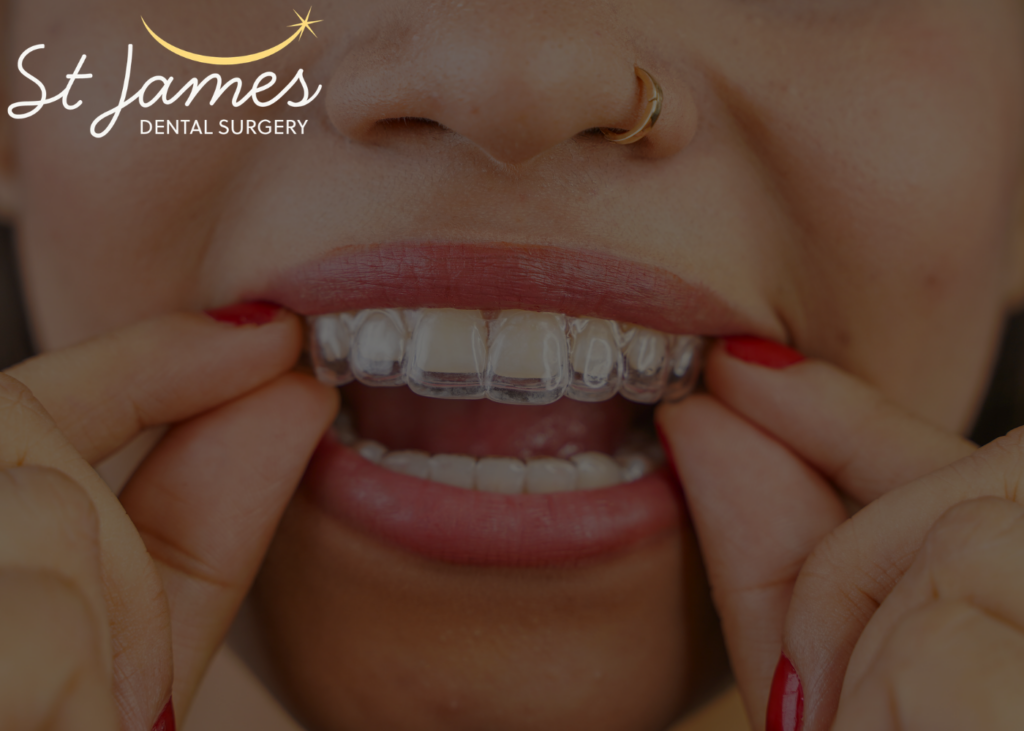
Invisalign is the most commonly used clear aligner system for correcting deep overbites, and it is particularly well suited to the dental and mild skeletal presentations that make up the majority of cases. The aligner works on a deep overbite through a combination of:
Intrusion of the front teeth: The aligners can be designed to push the upper front teeth slightly upward into the bone (intrusion), which reduces their vertical position and consequently reduces the overbite. This is achieved through precision bite ramps built into the aligner material that contact the lower front teeth and apply the intrusive force.
Extrusion of posterior teeth: By encouraging the back teeth to erupt slightly further, Invisalign increases the vertical dimension at the back of the bite, which automatically opens the front bite by the same amount.
Combination movements: Most overbite corrections involve a combination of incisor intrusion, posterior extrusion and controlled tooth movements throughout the arch.
The advantage of Invisalign for overbite correction compared to fixed braces is the removal convenience, the aesthetic discretion during treatment, and the ability to assess and adjust the treatment plan mid-course as the teeth respond. The precision digital planning of Invisalign allows the treating clinician to visualise the predicted outcome before treatment begins and to optimise the aligner design for the specific overbite correction needed.
Treatment duration for overbite correction with Invisalign varies from a few months for mild cases to 18 to 24 months for more significant presentations. Refinement aligners are commonly used to fine-tune the final position.
Tooth extractions to support overbite correction
In cases where the dental arches are crowded as well as having a deep overbite, creating space through carefully planned tooth extractions may be part of the orthodontic plan. Extracting specific teeth (most commonly upper and lower first premolars) allows the remaining teeth to be retracted, which can both relieve crowding and reduce the overbite as the front teeth are moved back.
The decision about whether extraction is needed is made during the orthodontic assessment, based on measurements of the dental arches, the degree of crowding, the skeletal pattern and the amount of overbite reduction required. Not every overbite case requires extractions; for many, non-extraction Invisalign treatment produces excellent results.
Restorative treatment for worn teeth
In patients who have had an uncorrected deep overbite for many years, the lower front teeth and sometimes the upper front teeth have often been worn by the abnormal contact pattern. Once the overbite is corrected, these worn teeth may need restorative treatment to rebuild them to their correct length, shape and surface texture.
Composite bonding on the lower front teeth is a common post-orthodontic restorative step: the worn incisal edges are rebuilt with tooth-coloured composite resin, restoring length, aesthetics and the contact relationship with the upper front teeth. Dr Neha Tailor’s biomimetic approach to composite placement focuses on replicating not just the appearance of the original enamel but its optical depth and layered character, producing restorations that are genuinely difficult to distinguish from natural unworn teeth.
For more significant wear, ceramic veneers or crowns may be appropriate. The restorative sequencing, orthodontics first, then definitive restorations, is planned from the outset as part of a comprehensive treatment approach.
Smile makeover for overbite correction
A comprehensive smile makeover approach brings together all elements of the treatment: orthodontic correction of the overbite and any associated crowding or spacing, whitening, restorative work on worn teeth, and any other aesthetic elements that address the full smile picture. For patients with a long-standing deep overbite and its associated aesthetic effects, this combination approach produces results that are transformative in a way that any single treatment element alone cannot.
The planning of a smile makeover for an overbite patient starts with the orthodontic correction: establishing the correct bite and tooth positions first, then designing the restorative work around that foundation.
Retainers: maintaining the correction
Orthodontic treatment for overbite correction is followed by a retention phase that is permanent. Retainers, either removable clear retainers or bonded wire retainers on the back of the front teeth, hold the corrected bite position. Without retention, the natural forces acting on the teeth would cause the overbite to relapse toward its original depth over time.
Retention is not a temporary afterthought: it is the phase that makes the orthodontic result permanent. Patients treated with Invisalign for overbite correction will typically use Vivera retainers (the Invisalign proprietary retention system) as part of their long-term management.
The bottom line
Overbite teeth are a common, clinically significant finding that produces progressive wear, potential joint loading and aesthetic concerns when left uncorrected. Most presentations of deep overbite, particularly those in the dental and mild skeletal category, respond well to orthodontic treatment.
Invisalign is an effective and aesthetically discreet option for correcting overbite teeth in adults, using precision-engineered bite ramps and planned tooth movements to reduce the vertical overlap and restore the correct bite relationship. Where tooth wear has occurred, restorative treatment with composite bonding or ceramic restoration rebuilds the affected teeth to their correct form once the orthodontic work is complete.
At St James Dental Surgery in Muswell Hill, the assessment of overbite cases includes the orthodontic evaluation, the restorative assessment of any existing wear, and the planning of a comprehensive treatment sequence that produces a stable, lasting result. Call 020 8365 2090 for a consultation at 18 Muswell Hill Broadway, London N10 3RT.
Disclaimer
The information in this article is intended for general educational guidance only and does not constitute personalised dental advice. For an assessment of your specific bite and the treatment options appropriate for your situation, please book an appointment with a qualified dental professional.
St James Dental Surgery is a private dental practice at 18 Muswell Hill Broadway, London N10 3RT, led by Dr Neha Tailor. We offer Invisalign for overbite correction, composite bonding, smile makeovers, tooth extractions, biomimetic dentistry, dental implants, porcelain veneers, teeth whitening, dental crowns and emergency appointments. Call 020 8365 2090.
Frequently asked questions
How do I know if I have a deep overbite?
The simplest check: bite your teeth together and look in a mirror. In a normal bite, the upper front teeth sit slightly in front of the lower front teeth and cover roughly a quarter of their length. In a deep overbite, the upper front teeth cover more than half the length of the lower front teeth, which may barely be visible. In a severe overbite, the lower front teeth are completely hidden. If you are unsure, a dental assessment that includes bite measurement is the definitive way to establish what your overbite actually is. The dentist will measure both the vertical and horizontal overlap as part of the examination.
Can Invisalign correct a deep overbite?
Yes, for most dental and mild skeletal deep overbites. Invisalign uses precision bite ramps and planned tooth movements to intrude the upper front teeth, extrude the posterior teeth, and redistribute the bite relationship into correct vertical proportions. The degree of overbite that can be corrected with Invisalign depends on the severity and the underlying cause: significant skeletal deep bites may require surgical intervention for a full correction, but most adult patients with deep overbites are suitable candidates for orthodontic management with aligners.
Does an overbite get worse over time if left untreated?
In many cases, yes. The forces that produced the overbite continue to act on the teeth throughout life. Tooth wear from abnormal contact continues progressively. Where the back of the bite is not supported by posterior teeth, continued over-eruption of the front teeth can deepen the overbite further. The longer an overbite goes uncorrected, the more secondary wear it produces, which ultimately requires additional restorative work. Earlier treatment produces simpler treatment.
Will treating my overbite affect how my face looks?
Correcting a deep overbite typically improves the facial profile. A deep overbite is often associated with a shorter-looking lower face, a retruded chin profile, and lips that are difficult to close at rest. Correcting the bite opens the lower face slightly, improves the lip seal, and in many cases produces a more balanced facial profile as well as a more functional bite. Smile makeover planning at St James Dental Surgery includes facial profile assessment as part of the overall treatment design.
My lower front teeth have been worn down by my overbite. Can they be rebuilt?
Yes. Composite bonding on worn lower front teeth is a common restorative step following overbite correction. The worn edges are rebuilt to their original length with tooth-coloured composite resin, restoring both aesthetics and the correct contact relationship. In some cases, ceramic veneers or crowns are more appropriate depending on the degree of wear. The restorative treatment is sequenced after orthodontic correction: fixing the bite first, then restoring the teeth within the corrected bite, produces stable, lasting results.