All-on-4 and full arch dental implants: a complete guide
Written with input from the clinical team at St James Dental Surgery in Muswell Hill, led by principal dentist Dr Neha Tailor (GDC 268120), with implant dentist Dr Phil Sterrett (GDC 73180).
For many people, it starts slowly. A tooth here, a tooth there. A bridge that fails. Gums that keep bleeding. Then one day you realise most of your teeth are loose, broken or missing, and you’re avoiding certain foods, covering your mouth when you laugh, or relying on a denture that never quite feels secure.
If that sounds familiar, you may have heard about All-on-4, sometimes called “teeth in a day”. It’s a way of replacing a whole arch of teeth with a fixed set that’s held in place by dental implants, and it has changed life for a lot of people.
At St James Dental Surgery, our team offers full arch treatment alongside other options, and we always start by asking one question: is this the right solution for you? This guide explains how full arch dental implants work, who they suit, what’s involved and how they compare with the alternatives.
What is All-on-4?
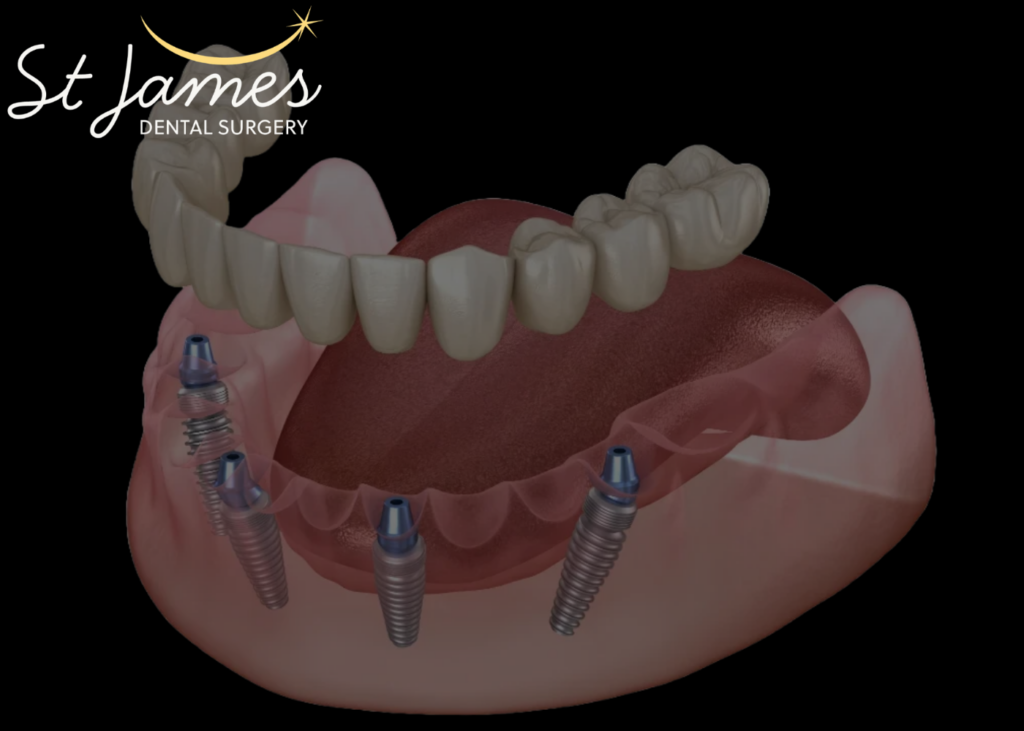
All-on-4 is a type of full arch treatment where a complete set of teeth for the upper or lower jaw is fixed onto just four dental implants.
- Two implants are placed straight at the front of the jaw, where the bone is usually strongest
- Two implants are placed at an angle further back, which lets them use the available bone and avoid structures like the sinuses and nerves
- A fixed bridge of teeth is then attached to the implants. It doesn’t come out, so you clean it in your mouth like natural teeth
All-on-6 works in the same way but uses six implants. This can give extra support in some situations, depending on your bone and bite.
You can find out more about how we approach this on our page about All-on-4 and All-on-6 same-day teeth.
Because the angled implants make the most of the bone you have, many people who’ve been told they don’t have enough bone for implants can still have All-on-4 without needing extensive bone grafts. That isn’t true for everyone, which is why a proper assessment matters.
If you’re new to implants, our page on dental implants in Muswell Hill explains how a single implant works and why it’s so stable once healed.
Who are full arch dental implants for?
Full mouth dental implants are usually considered for people who:
- Have lost most or all of their teeth in one or both jaws
- Have many teeth that are failing because of gum disease, decay or repeated breakages
- Wear dentures that are loose, uncomfortable or affect eating and speaking
- Want a fixed solution rather than something that comes out
They may not be suitable straight away for people who smoke heavily, have uncontrolled diabetes, have had radiotherapy to the jaw, or take certain medicines that affect bone healing. These don’t always rule treatment out, but they need careful planning.
Before choosing full arch: can any teeth be saved?
This is an important and honest question. Full arch treatment involves removing any remaining teeth in that jaw. For some people, that’s the right decision. For others, saving some teeth may be better.
At St James, Dr Neha Tailor offers biomimetic dentistry, a tooth-saving approach that can restore teeth that are cracked, heavily filled or weakened, often without crowns. If your remaining teeth are healthy enough to restore, a combination of saving teeth and replacing missing ones with individual implants or a bridge may be a better long-term option.
We’ll always talk through every option. Full arch treatment is a big decision, and it should only be recommended when it’s genuinely the best one.
If you’re unsure, it’s worth reading about biomimetic dentistry before deciding. Some people also choose to have one painful, failing tooth removed first with a straightforward tooth extraction, then plan their long-term treatment without pressure.
How full arch compares with other options
|
Option |
Fixed or removable? |
How it’s supported |
Things to know |
|---|---|---|---|
|
Conventional denture |
Removable |
Rests on the gums |
Least invasive and lowest cost; can feel loose, especially lower dentures; doesn’t prevent bone loss |
|
Implant-retained denture |
Removable |
Clips onto two or more implants |
Much more secure than a standard denture; comes out for cleaning |
|
All-on-4 or All-on-6 |
Fixed |
Four or six implants per jaw |
Feels most like natural teeth; doesn’t come out; helps preserve the jawbone |
|
Individual implants |
Fixed |
One implant per tooth, or bridges on implants |
Best when only some teeth are missing and the rest are healthy |
If a removable option suits you better, we also offer implant-retained dentures, which are a good middle ground for many people.
What the All-on-4 process involves
Every treatment plan is different, but this is the typical journey.
|
Stage |
What happens |
Typical timing |
|---|---|---|
|
Consultation |
We discuss your goals, examine your mouth, and take X-rays or a 3D scan to assess your bone |
First visit |
|
Planning |
Your implant positions and new teeth are planned digitally |
Usually a few weeks |
|
Treatment day |
Any remaining teeth are removed, implants are placed and, in most cases, a fixed temporary set of teeth is fitted the same day |
One day |
|
Healing |
The implants bond with the bone. You’ll eat a softer diet at first |
Usually three to six months |
|
Final teeth |
Your permanent bridge is made and fitted, designed for strength, comfort and appearance |
After healing |
|
Maintenance |
Regular check-ups and hygiene visits to keep implants and gums healthy |
Ongoing |
Treatment day
Most patients are surprised by how much happens in one appointment. Any remaining teeth are removed with a careful tooth extraction, the implants are placed, and a temporary fixed bridge is usually attached the same day, so you leave with teeth.
Whether same-day teeth are possible depends on how firmly the implants are held in the bone on the day. Your dentist will explain this beforehand, so there are no surprises.
Treatment is carried out under local anaesthetic, and many people choose additional help to stay relaxed for a longer appointment. If you’re nervous, tell us early so we can plan with you.
You can read more about each stage of implant treatment in our guide to the dental implant process.
Living with full arch implants
Eating
For the first few months, while the implants heal, you’ll be advised to stick to softer foods. Once your final teeth are fitted, most people can eat a much wider range of foods than they could with dentures, including things like steak, apples and crusty bread.
Speaking and confidence
Because the teeth are fixed and there’s no plate covering the roof of your mouth, many people find speaking feels more natural, and they no longer worry about their teeth moving when they laugh or talk.
Cleaning
Full arch teeth don’t come out, so you clean them in your mouth every day. This includes brushing, and cleaning underneath the bridge with interdental brushes, special floss or a water flosser. Regular hygiene appointments are essential, because gum inflammation around implants can lead to problems if it isn’t kept under control.
How long do they last?
With good care, dental implants can last for many years. The bridge on top may need maintenance over time, such as replacing worn teeth or adjusting the fit, just as natural teeth and other restorations do.
The same is true of individual dental implants: looking after the gums around them is the single most important thing you can do to help them last.
Is All-on-4 right for you?
All-on-4 may suit you if you:
- Have few remaining teeth, or teeth that can’t realistically be saved
- Want fixed teeth rather than a removable denture
- Are generally in good health
- Are willing to look after your new teeth with daily cleaning and regular check-ups
It may not be the best choice if most of your natural teeth can be saved, if you’d rather have a removable option, or if health factors make implant treatment higher risk. A consultation is the only way to know for sure.
When problems can't wait
If you’re living with failing teeth, problems can flare up suddenly. Severe toothache, swelling, a broken tooth or a denture that’s snapped can all happen before you’ve made a decision about long-term treatment.
If that happens, our emergency dentist appointments can get you out of pain and stabilise things, so you can then think about your options calmly rather than in a crisis.
Our emergency dentist service aims to see patients in pain as quickly as possible, with same-day appointments available.
Why patients choose St James Dental Surgery
St James Dental Surgery is a private dental practice at 18 Muswell Hill Broadway, led by principal dentist Dr Neha Tailor. Implant treatment, including full arch, is carried out with Dr Phil Sterrett, our implant dentist. Our team also includes associate dentist Dr Maurice Dadoun (GDC 72277).
What makes us different is that we offer the full picture: tooth-saving biomimetic dentistry, individual implants, implant-retained dentures and full arch dental implants. That means our advice is based on what’s best for you, not on one particular treatment. We’ll explain your options honestly, with clear costs, and finance options are available.
You can call us on 020 8365 2090 to arrange a consultation.
Disclaimer
The information in this article is intended for general educational guidance only and does not constitute personalised dental advice. For an assessment of your specific bite and the treatment options appropriate for your situation, please book an appointment with a qualified dental professional.
St James Dental Surgery is a private dental practice at 18 Muswell Hill Broadway, London N10 3RT, led by Dr Neha Tailor. We offer Invisalign for overbite correction, composite bonding, smile makeovers, tooth extractions, biomimetic dentistry, dental implants, porcelain veneers, teeth whitening, dental crowns and emergency appointments. Call 020 8365 2090.
Frequently asked questions
What is the difference between All-on-4 and All-on-6?
Both replace a full arch of teeth with a fixed bridge on implants. All-on-4 uses four implants, while All-on-6 uses six. The right choice depends on your bone, your bite and how much support your new teeth need. Your dentist will recommend the best option after assessing your jaw.
Can I really get teeth in a day?
In many cases, yes. If the implants are held firmly enough on the day of surgery, a temporary fixed set of teeth can be attached straight away. Your permanent teeth are fitted a few months later, once the implants have healed.
Is All-on-4 painful?
Treatment is carried out under local anaesthetic, so you shouldn’t feel pain during the procedure. Afterwards, some swelling and discomfort are normal for a few days and are usually managed with over-the-counter painkillers and a soft diet.
Do I need a bone graft for full arch implants?
Not always. One of the advantages of All-on-4 is that the angled back implants can often make use of the bone you already have, so many people avoid a bone graft. A 3D scan at your consultation will show whether you have enough bone.
How do I clean full mouth dental implants?
You brush your new teeth twice a day and clean underneath the bridge daily with interdental brushes, special floss or a water flosser. Regular check-ups and hygiene visits are important to keep the gums around your implants healthy.