
Do I need a crown? The alternatives that keep more of your tooth
Written with input from the clinical team at St James Dental Surgery in Muswell Hill, led by principal dentist Dr Neha Tailor (GDC 268120).
“You need a crown.” It’s one of the most common things patients hear at the dentist, and one of the most common things they come to us to question. Often it’s a back tooth with a big old filling, a crack, or a tooth that’s had root canal treatment. Sometimes it doesn’t even hurt.
Crowns have been the standard answer for decades, and in the right situation they’re an excellent treatment. But they aren’t the only option. Modern bonding techniques mean many teeth that would once have been crowned can now be repaired in a way that keeps far more of the natural tooth.
At St James Dental Surgery, our principal dentist Dr Neha Tailor takes a tooth-saving approach called biomimetic dentistry. This guide explains when a crown really is needed, what the alternatives are, and how to work out which is right for you.
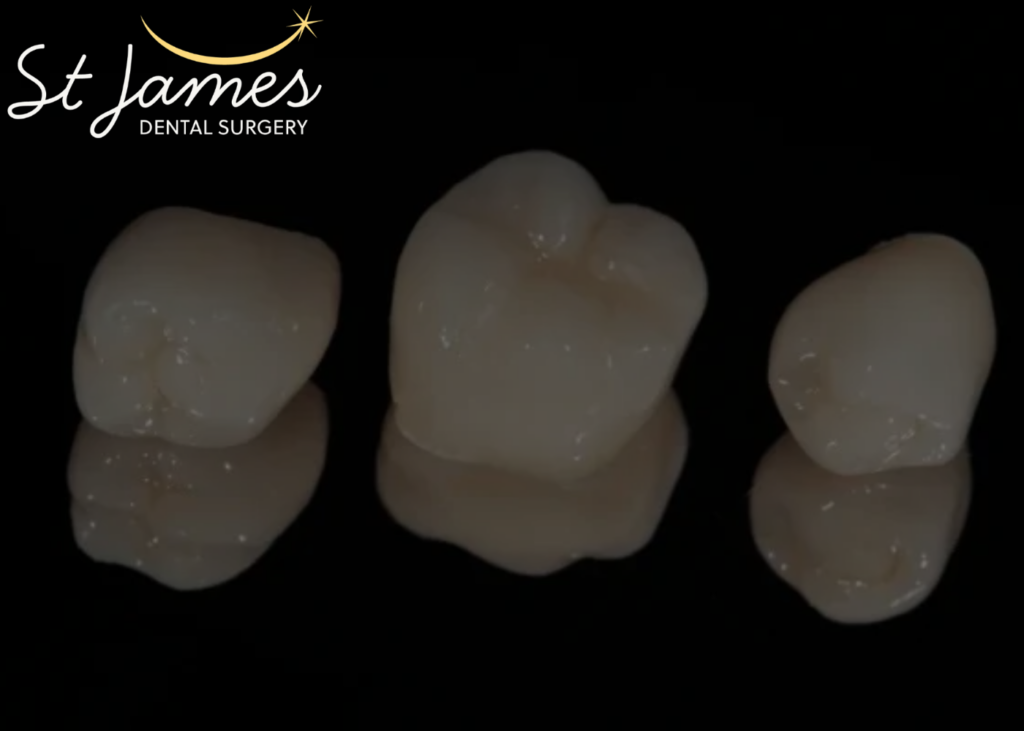
What a crown actually involves
A crown is a cap that covers the whole visible part of a tooth. To make room for it, the tooth has to be shaped down on every side, including healthy areas that aren’t damaged.
That’s the main drawback. Research has shown that preparing a tooth for a traditional full crown can remove more than half of the tooth structure above the gum. Healthy enamel, once removed, can’t be put back. And the more a tooth is drilled, the more stress is put on the nerve inside, which can occasionally lead to the nerve dying later on.
None of this means crowns are bad. It means they should be used when they’re the best option for that tooth, not simply because they’re the familiar one.
When a crown is usually recommended
Dentists typically suggest a crown when:
- A tooth has a very large filling and little natural tooth left
- A tooth is cracked
- A back tooth has had root canal treatment and needs protecting
- A tooth has broken
- A tooth is badly worn from grinding
- A tooth is discoloured or misshapen
These are all real reasons to protect a tooth. The question is whether a full crown is the only way to do it. Often, it isn’t.
The main dental crown alternatives
Biomimetic restorations
“Biomimetic” means copying nature. Biomimetic dentistry rebuilds a damaged tooth in layers designed to behave like natural enamel and dentine, so the tooth flexes and handles biting forces the way a healthy tooth does.
The key ideas are:
- Remove only what’s damaged, such as decay, old filling material and the cracked part of the tooth, and keep everything healthy
- Bond the restoration firmly to the tooth, creating a tight seal that keeps bacteria out
- Build the restoration up in careful layers to reduce stress on the tooth
- Cover and support weakened areas only where needed, rather than cutting the whole tooth down
For many cracked or heavily filled teeth, this means they can be restored without a full crown, keeping much more natural tooth and protecting the nerve.
Our page on biomimetic dentistry in Muswell Hill explains the process in more detail, including how each layer is built up and bonded.
Onlays and overlays
An onlay is a custom-made restoration that covers only the parts of the tooth that need protecting, such as one or more of the biting cusps. An overlay covers the whole biting surface but doesn’t go all the way down the sides like a crown does.
Onlays are usually made from ceramic or composite and bonded to the tooth. They’re a strong, long-lasting alternative to a dental crown for back teeth with large fillings or after root canal treatment, and they often need far less drilling.
Large bonded fillings
For teeth that are damaged but still fairly strong, a well-placed bonded composite filling can sometimes do the job. Modern materials and techniques allow larger areas to be rebuilt reliably, often in a single visit.
Veneers and composite bonding for front teeth
If the main concern with a front tooth is its colour or shape, rather than its strength, a veneer or composite bonding can change its appearance while keeping most of the natural tooth intact.
Comparing your options
Option | How much healthy tooth is removed | Typical number of visits | Best for |
|---|---|---|---|
Full crown | A lot, around the whole tooth | Usually two | Teeth with very little tooth left, badly broken teeth, implants |
Onlay or overlay | Much less; only the areas needing cover | Usually two | Back teeth with large fillings or after root canal treatment |
Biomimetic restoration | As little as possible; only damaged tooth | One or two, depending on the tooth | Cracked, heavily filled or weakened teeth |
Large bonded filling | Little | Usually one | Moderate damage in an otherwise strong tooth |
Veneer or bonding | Little to none, front surface only | One to three | Front teeth needing colour or shape changes |
Every tooth is different, so this is a general guide. Your dentist will look at your X-rays and the tooth itself before recommending anything.
When a crown is still the right choice
Being honest about alternatives means being honest about when a crown is the better option. A crown is often still recommended when:
- There’s very little tooth left above the gum to bond to
- The tooth is badly broken below the gumline
- It’s sitting on a dental implant. Implant crowns are a different situation, as there’s no natural tooth to preserve
- It’s supporting a bridge
- A previous crown needs replacing and the tooth underneath is already shaped for one
In these cases, a well-made dental crown is the most reliable way to protect the tooth.
With crowns on dental implants, there’s no natural tooth to preserve, so the usual concerns about drilling away healthy tooth don’t apply.
Cracked teeth: where the choice matters most
Cracks are one of the most common reasons people are told they need a crown, and one of the areas where biomimetic dentistry can make the biggest difference.
A crown holds a cracked tooth together from the outside. A biomimetic approach looks at the crack directly, removes as much of it as possible, then bonds and seals the tooth from the inside to stop the crack spreading. For many cracked teeth, this protects the tooth while keeping more of it.
If the crack runs too deep, down into the root, the tooth may not be saveable at all. In that case, a tooth extraction may be the best option. Our guide on whether a cracked tooth can be saved explains how dentists make that call.
After root canal treatment
Back teeth that have had root canal treatment do need protecting, because they become more brittle and are more likely to break when you bite. Traditionally, that meant a crown.
Today, an onlay or a biomimetic restoration that covers the biting surface can often give the same protection with less drilling. The important thing is that the tooth is protected properly, whichever method is used.
Questions to ask if you've been told you need a crown
If you’re wondering “do I need a crown?”, these questions can help you understand your options:
- Why does this tooth need protecting? Is it a crack, a large filling, root canal treatment or something else?
- How much healthy tooth will be removed?
- Is an onlay, overlay or biomimetic restoration possible instead?
- What are the risks to the nerve?
- How long is each option expected to last?
- What happens if I wait?
A good dentist will be happy to answer all of these and explain the pros and cons of each option, not just one.
What if the tooth can’t be saved?
Sometimes, despite everyone’s best efforts, a tooth is too damaged to restore. If it needs to come out, a dental implant is often the closest thing to a natural tooth. It’s placed in the jawbone and topped with a crown, without relying on the teeth next to it.
The damaged tooth is removed first with a careful tooth extraction, and the implant is usually placed once the area has had time to heal.
At St James, implant treatment is carried out with Dr Phil Sterrett (GDC 73180), our implant dentist. Our article on the dental implant process explains each stage.
If a tooth breaks before you’ve decided
If a heavily filled or cracked tooth suddenly breaks, becomes painful or loses a large filling, don’t wait for a routine appointment. Our emergency dentist appointments mean we can protect the tooth quickly, often with a temporary repair, and then talk through the long-term options calmly once you’re comfortable.
If you have swelling, throbbing pain or a bad taste, the tooth may be infected. Our guide to tooth infection symptoms explains what to look out for.
Why patients choose St James Dental Surgery
St James Dental Surgery is a private dental practice at 18 Muswell Hill Broadway, led by principal dentist Dr Neha Tailor. Our team includes associate dentist Dr Maurice Dadoun (GDC 72277) and implant dentist Dr Phil Sterrett. We’re open Monday to Friday from 9am to 6pm and on Saturday mornings, with same-day appointments available for patients in pain.
Our approach is simple: find the cause, get you comfortable, and save your natural tooth wherever that’s genuinely the best option. When it isn’t, we’ll tell you honestly and help you plan what comes next. If you think you have a tooth infection, please don’t wait for it to get worse.
For urgent problems, our emergency dentist service aims to see patients in pain as quickly as possible. You can also find our full range of treatments, fees and team on the St James Dental Surgery website.
You can call us on 020 8365 2090.
Disclaimer
The information in this article is intended for general educational guidance only and does not constitute personalised dental advice. For an assessment of your specific bite and the treatment options appropriate for your situation, please book an appointment with a qualified dental professional.
St James Dental Surgery is a private dental practice at 18 Muswell Hill Broadway, London N10 3RT, led by Dr Neha Tailor. We offer Invisalign for overbite correction, composite bonding, smile makeovers, tooth extractions, biomimetic dentistry, dental implants, porcelain veneers, teeth whitening, dental crowns and emergency appointments. Call 020 8365 2090.
Frequently asked questions
Do I need a crown after a root canal?
Back teeth usually need protection after root canal treatment, because they become more brittle. That protection doesn’t always have to be a full crown. An onlay or a biomimetic restoration that covers the biting surface can often do the same job while keeping more of the tooth
What is the best alternative to a dental crown?
It depends on the tooth. For back teeth with large fillings or cracks, onlays and biomimetic restorations are often the best alternatives. For front teeth needing a change in colour or shape, veneers or composite bonding may be more suitable.
Is biomimetic dentistry as strong as a crown?
When it’s suitable for the tooth, biomimetic dentistry is designed to be strong and long-lasting, because it bonds to the tooth and supports it from the inside. It isn’t right for every tooth, so your dentist will assess whether it’s a good option for yours.
Can I get a second opinion on a crown?
Yes. It’s completely reasonable to ask for a second opinion, especially as crowns involve removing healthy tooth that can’t be replaced. A second opinion can confirm whether a crown is needed or whether there’s a more conservative option.
What happens if I don't get a crown when I need one?
If a weakened tooth isn’t protected, it’s more likely to crack or break, sometimes in a way that can’t be repaired. That’s why it’s important to get some form of protection, whether that’s a crown or one of the dental crown alternatives your dentist recommends.